
Altima NSX
Light in weight. Light in price. Heavy in features.
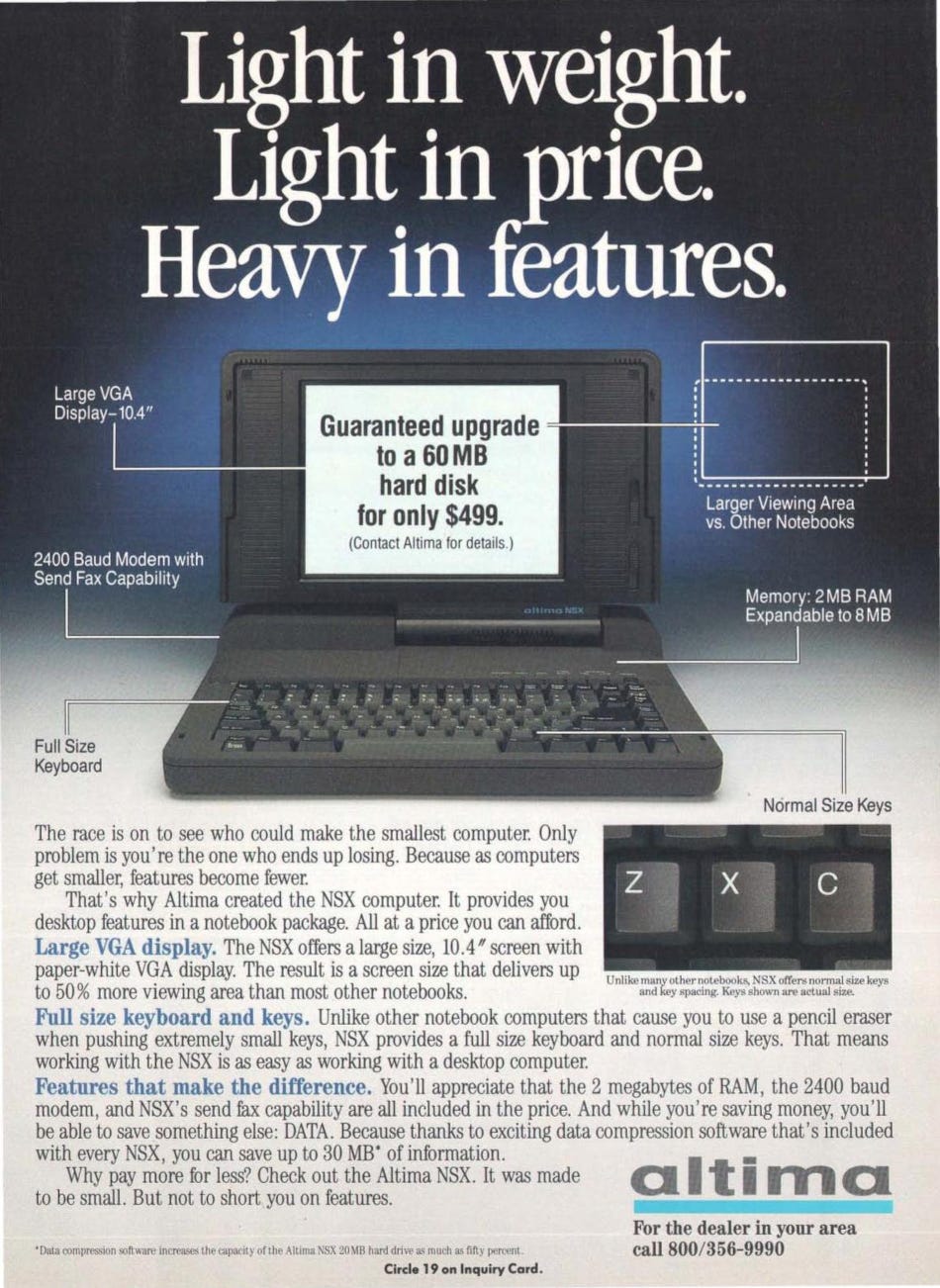
The Company
The ad should also read “light on company information”. Unfortunately, Altima is one of many computer companies that existed for a short time in the 1980s and then disappeared without a trace. To me, that is sad. One of the main reasons that I started this newsletter was to bring at least a small spotlight to the many small companies that helped create the personal computer.
I couldn’t find corporate records for Altima, but I did uncover a few scraps of information. The history section of the Macnica site says that Altima Corporation was founded in 1991. However, Bloomberg says Altima Computer was founded in 1995. George Kao, the senior vice president of Operations at Supermicro, previously worked at Altima for several years. According to his bio, Altima was sold to Broadcom. Wikipedia corroborates that Altima Communications was sold to Broadcom in 2000. Hopefully, all of these Altimas are the same.
The Computer
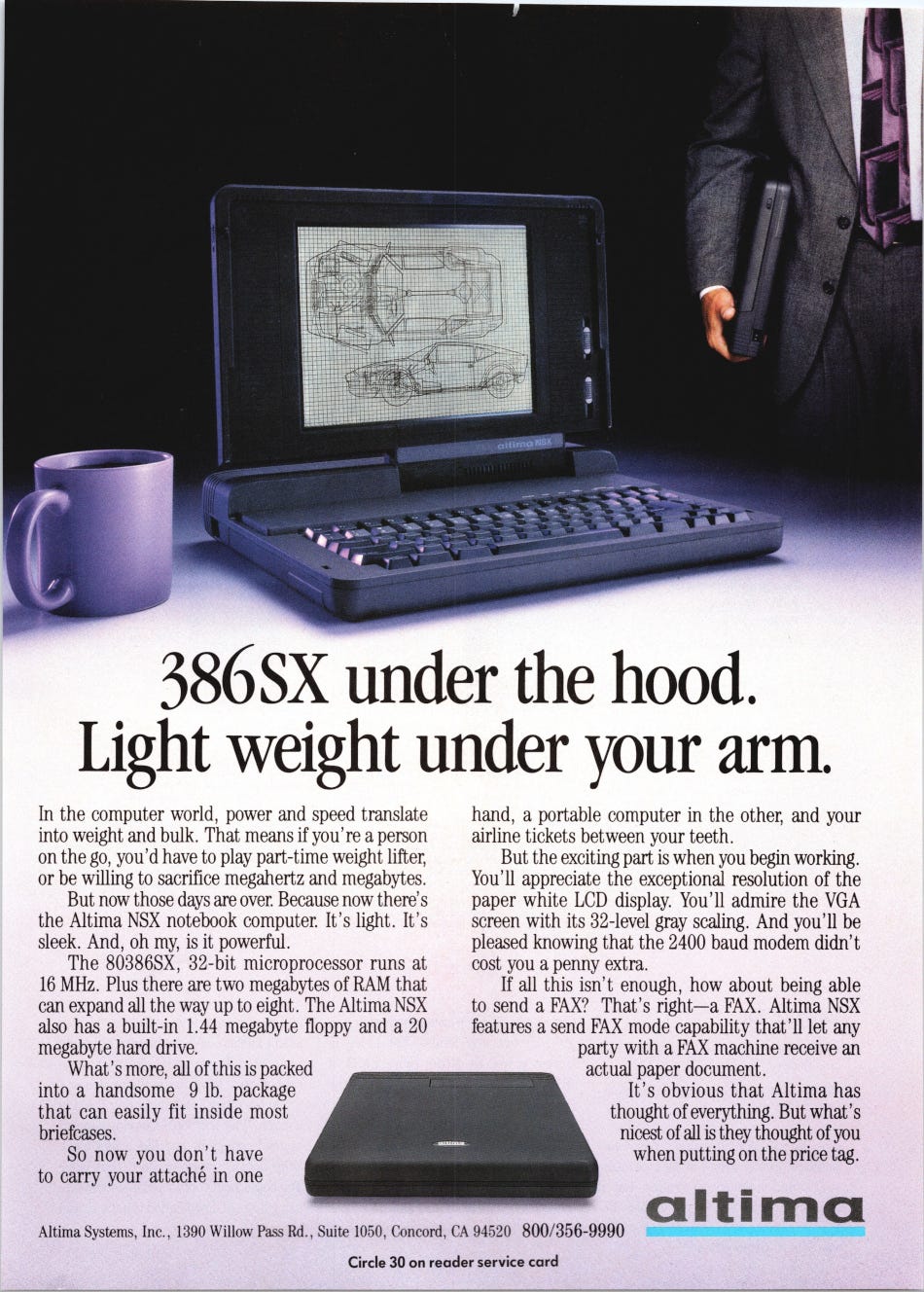
The first mention I found for this system was in the August 1990 issue of PC World. Mike Hogan wrote an article for that issue entitled “Portable Reach the Limit: Tiny PCs Still Have to Be Usable”. He said the following about the NSX:
Notebook leaders are about to launch a new generation of products that will make VGA screens and 20MB hard drives de rigueur. Just over the horizon are 386SX notebooks. Altima Systems in Concord, California, touts its Altima NSX as the first “notebook computer combining 80386SX technology, VGA display, and a 20MB hard disk drive.” But with a footprint of 11 by 14 by 2 inches, the NSX takes up a bit too much room.
The Byte Magazine from the same month also mentioned the NSX in their new hardware section:
Laptop SX Features Backlit VGA and Two Disk Drives
The Altima NSX is a 9 3/10 pound 386SX computer with an internal 20-MB hard disk drive, an internal 3 1/2-inch 1.44-MB floppy disk drive, and a 10 3/5-inch backlit VGA display.
The basic system comes with 2 MB of RAM (expandable to 8 MB), one parallel port, two serial ports, a 2400bps internal modem with send-fax capabilities at up to 4800 bps, an 83-key keyboard, and an external keyboard port. Access time on the 2 1/2-inch hard disk drive is 28 ms. The internal battery will last 1 1/2 hours. System dimensions are 14 1/3 by 11 by 2 2/10 inches. DOS 4.01 and GW-BASIC are included.
Price: $4999.
Contact: Altima Systems, Inc., 1390 Willow Pass Rd., Suite 1050, Concord, CA 94520, (800) 356-9990 or (415) 356-5600.
The German computer magazine HCC Nieuws Brief for March 1991 wrote a short intro to the system: (Translated with Kagi)
The Altima NSX is a highly compact and complete laptop. The machine features an 80386SX processor with a switchable clock speed of 8 or 20 MHz. The internal memory comes standard with 2 MB of RAM, expandable up to 8 megabytes.
The paper-white backlit LCD screen has a 640 x 480 VGA resolution and is capable of displaying 32 shades of gray.
The Altima NSX has a 20 MB internal hard disk with an access time of 28 ms. A 1.44 MB 3.5" floppy drive is part of the standard equipment.
Among the basic features of the Altima NSX is a 2400 baud internal Hayes-compatible modem with fax transmission capability. In addition to the parallel printer port and RS-232 serial port, the Altima NSX includes a 15-pin VGA output and an external keyboard port. A removable 20 watt-hour nickel-cadmium battery is also included as standard.
Rod Chapin and Patrick Lyons compared 8 386SX notebooks for InfoWorld, including ALR Venture 16-386SX, Altima NSX, Compaq LTE 386S/20, Everex Tempo LX, Samsung Notemaster SX, Texas Instruments Travelmate 3000, Twinhead Supernote SX, and the Zeos Notebook 386. Here are a couple of highlights:
Disk Speed: The NSX was one of the slowest performers. Score: Good.
Size/Weight: The NSX weighs about 10 pounds with its battery, which is quite a bit heavier than what is commonly thought of as a notebook weight. For many notebook users. 10 pounds may be too much, but we tested this system as a notebook because it is sold as one. Score: Poor.
Battery Life: The Altima’s nickel-cadmium battery lasted only 1 hour, 20 minutes, and 54 seconds on our tests — the shortest battery life we found. This time is just a few minutes above the 1 hour and 1 5 minutes we require for a satisfactory score. Score: Satisfactory.
Screen Readability: The Altima has the largest screen of any notebook in this comparison, and its font is not very bold. The NSX’s VGA card has an on-board memory of 256K, and there are 16 shades of gray at 640-by-480 resolution. The brightness and contrast controls for the VGA work wonderfully.
The screen does wash out considerably from angles and is most comfortable to look at from directly in front of the machine. The Altima’s display was judged to be average on our taste tests. Score: Satisfactory.
Keyboard: The Altima’s 83-key keyboard has very spongy action that may be difficult to adjust to. However, the keys are full-size and the arrangement of the keyboard is very logical. The keyboard was fairly well liked on our taste tests. Score: Satisfactory.
System Design: The Altima is a bulky but well-designed machine. Attention to detail is evident on the case and its hardware. All of the controls work smoothly. The screen has very little play when adjusted and closes firmly. It can be difficult to open the cover because of the nonstandard working of its latches. Score: Satisfactory.
Value: At $3,499. the Altima NSX is priced above some other comparable notebooks, but is much less expensive than the Compaq. This machine is about as large and heavy as notebooks get, but if you prefer large displays and full-size keyboards, the extra weight may be justified. Score: Satisfactory.
MicroTimes awarded the NSX the “Computer of the Month” for July 1991. Here is their review:
When Altima unveiled their first computer a couple of years ago, it generated a lot of favorable press. It was rugged. It was designed for the power user. Though it weighed a lot, it gave a lot. The initial model has been upgraded several times over the last couple of years and is still highly competitive in its market. But now, they have released a notebook computer with a completely new design.
Although the Altima NSX is a bit heavier than many notebook models, it is true to the Altima tradition. It is powered by a 386SX processor running at 16MHz, switchable to 8MHz. It weighs 9.3 lbs. and measures 11" x 14" x 2". It has a 20 MB hard drive and a high-density 3.5" floppy drive. It comes standard with 2MB of RAM, expandable to 8MB by the addition of memory cards ($599 for 2MB). You also get a built-in modem-fax card.
The unit is stylishly designed. It looks great. However, I do miss handles: whether a case is included or not, eventually you have to carry the computer. When you open the NSX you see a large LCD. Measuring about 10.5" diagonally, it makes reading text less taxing than some of the smaller notebook models. The backlit screen features a black display on white background. Altima makes it easy should you want to use an external monitor with the NSX. Just plug in the monitor and indicate in the setup program to expect the external monitor. Additionally, you can change from an internal to external display through either a DOS command or a function key instruction. If you choose to use an external monitor, it must be either a VGA or multiscan model. There is a 15-pin connector, and the internal graphics will support only these classes of monitors. Software written to the older graphics standards is, of course, still usable as it will display well on either a multisync or VGA monitor.
The keyboard is a real pleasure. After working on so many small notebook computers with tiny keyboards, I really appreciate a comfortable one. After all, that is one of the two ways in which you have most of your interaction with the computer. It really is good to have a keyboard that allows you to work at full capacity. Despite my praise for this keyboard, I realize that keyboard taste is rather subjective. And that is one of the reasons Altima includes a port for attaching the keyboard of your choice. I have found that I prefer to keep a favorite keyboard wherever I will most often be using a laptop. I suppose part of the decision when selecting which model to purchase rests in part on whether you will be using this as a primary computer or in connection with a desktop machine. But back to the keyboard. One of the things I don’t like is the embedded numeric keypad. Fortunately you can get around this objection with the addition of a numeric keypad ($99).
Altima has included an interesting modem. It is 2400 baud and Hayes compatible. In addition, it can send—but not receive—faxes at 4800 baud. While that is half the speed of a standard fax transmission, it is convenient to be able to send a fax from your computer in a pinch. There is one catch in this fax system, however. You must have communications software that handles fax transmissions. The documentation doesn’t mention any software, so you will have to search around for the appropriate package. If you need better fax capabilities, there are _ several small units that will attach to the serial port. These units all have the necessary | software. I have also seen press announcements about a product that will allow any computer to send faxes over their existing modems. I will keep my eyes open for this product.
The battery system on the NSX is a mixed bag. On the one hand, the battery pack recharges in less than two hours, but it doesn’t last all that long. You can increase the time the battery will power the computer by using standard techniques such as running at the slower speed and turning off the display and hard drive during a period of nonuse. All of these variables are controlled through a setup program that is well documented in the booklet that comes with the computer. The instruction booklet is small, but quite adequate. Although I prefer a concise book to a weighty tome, the quality of this book is beneath that of the machine itself.
There are some options available. A 5.25" serial port, makes it easy to transfer older software that you do not have on 3.5" disks yet. A math coprocessor ($449) is available but must be installed by Altima. Extra battery packs are $99.
I have been told Altima will soon offer a 60MB hard disk. Computers that are bought I before the larger hard disk is available will be eligible for buying an upgrade. In addition, they will offer the computer with a 20MHz central processor.
Are you looking for an NSX of your own? I found one on eBay in pretty rough shape. Do not recommend.
Did you ever use an Altima NSX? Tell us about it in the comments below.

What computer ads would you like to see in the future? Please comment below. If you enjoyed it, please share it with your friends and relatives. Thank you.
This is a great one! I remember the laptop, and I'm sure some of us "of a certain age" will notice the Altima and NSX names and think about the cars of the time. Here are a couple of unrelated tidbits:
- Honda began making the glorious Acura NSX in 1991, the same year as the article.
- The Nissan Altima began production for the US shortly later in 1992 (and the name was already being kicked around on foreign models). I can't find the original sticker price of the '92 Altima, but I bet that it isn't wildly far from the laptop price.
- And now it gets weird. Do you remember the story of Uzi Nissan? He owned a small computer shop and beat Nissan motors to the "nissan.com" domain and fought them HARD for the latter part of his life to keep it. He didn't want to sell it, and even more, didn't want it legally wrestled away from him, and won! Uzi may be gone, but he's still got the domain, so go check it out.
I never had this model, but I was a dealer for Altima and did sell a few of the Altima Ones. Altima one was a luggable 286 system with a full keyboard and mouse. It was an interesting machine.