
Bridge 3C Computer
Develop two programs for the time of one.

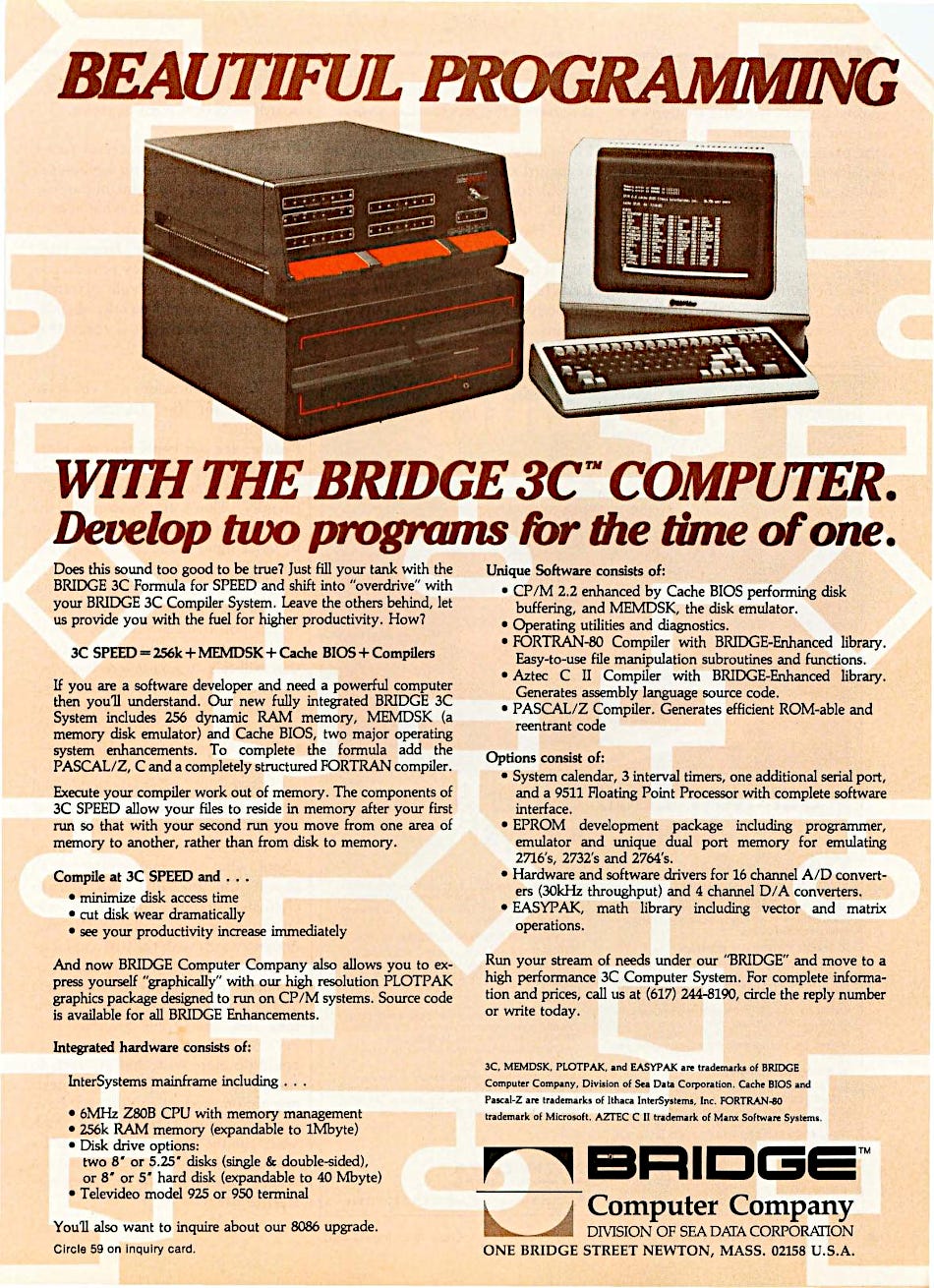
The Company
I couldn’t find any information about Bridge Computer Company. Neither the Massachusetts’ Secretary of State or the OpenCorporates has any info. I did find a listing for the company in the Newton, MA city directory. In the 1980s, the company was an authorized distributor for InterSystems computers.
According to the ad, BCC was a division of Sea Data Corporation. The Massachusetts’ SOS notes that Sea Data was incorporated on May 12, 1972 by I. Winfield Hill and Virginia Burns Hill. In February 1987, the company’s name was changed to S. D. Liquidation Corp. The company was finally dissolved at the end of 1990.
The Computer
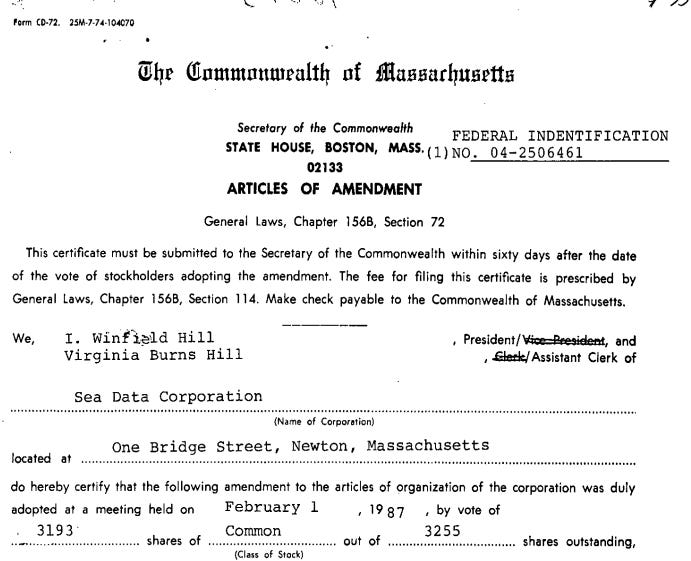
I couldn’t find any reviews for the Bridge 3C system, so here is the contents of the above ad.
Develop two programs for the time of one.
Does this sound too good to be true? Just fill your tank with the BRIDGE 3C Formula for SPEED and shift into “overdrive” with your BRIDGE 3C Compiler System. Leave the others behind, let us provide you with the fuel for higher productivity. How?
3C SPEED = 256k + MEMDSK + Cache BIOS + Compilers
If you are a software developer and need a powerful computer then you’ll understand. Our new fully integrated BRIDGE 3C System includes 256 dynamic RAM memory, MEMDSK (a memory disk emulator) and Cache BIOS, two major operating system enhancements. To complete the formula add the PASCAL/Z, C and a completely structured FORTRAN compiler.
Execute your compiler work out of memory. The components of 3C SPEED allow your files to reside in memory after your first run so that with your second run you move from one area of memory to another, rather than from disk to memory.
Compile at 3C SPEED and...
minimize disk access time
cut disk wear dramatically
see your productivity increase immediately
And now BRIDGE Computer Company also allows you to express yourself “graphically” with our high resolution PLOTPAK graphics package designed to run on CP/M systems. Source code is available for all BRIDGE Enhancements.
Integrated hardware consists of:
InterSystems mainframe including...
6MHz Z80B CPU with memory management
256k RAM memory (expandable to 1Mbyte)
Disk drive options: two 8” or 5.25” disks (single & double-sided), or 8” or 5” hard disk (expandable to 40 Mbyte)
Televideo model 925 or 950 terminal
Unique Software consists of:
CP/M 2,2 enhanced by Cache BIOS performing disk buffering, and MEMDSK, the disk emulator.
Operating utilities and diagnostics.
FORTRAN-80 Compiler with BRIDGE-Enhanced library. Easy-to-use file manipulation subroutines and functions.
Aztec C II Compiler with BRIDGE-Enhanced library. Generates assembly language source code.
PASCAL/Z Compiler. Generates efficient ROM-able and reentrant code
Options consist of:
System calendar, 3 interval timers, one additional serial port, and a 9511 Floating Point Processor with complete software interface,
EPROM development package including programmer, emulator and unique dual port memory for emulating 2716s, 2732’s and 2764’s.
Hardware and software drivers for 16 channel A/D converters (30kFiz throughput) and 4 channel D/A converters
EASYPAK, math library including vector and matrix operations.
Run your stream of needs under our “BRIDGE” and move to a high performance 3C Computer System. For complete information and prices, call us at (617) 244-8190, circle the reply number or write today.
Have you ever used any Bridge Computer Company products? Tell us about it in the comments below.

Hmmm.... Where do I start? Your searches brought up a few unanswered questions right off the bat, wrt the company registration, etc.
I started reading and then stopped, merely skimming the rest after coming across "256 dynamic RAM memory" - 256 what of DRAM? PetaBytes? Okay, so that's just grammar, yet it continues, so not a good look for someone marketing a $6000 product with a proofed magazine ad.
But that's not all, and this didn't so much as give me a chuckle, as questioning the authenticity of the ad's provenance:
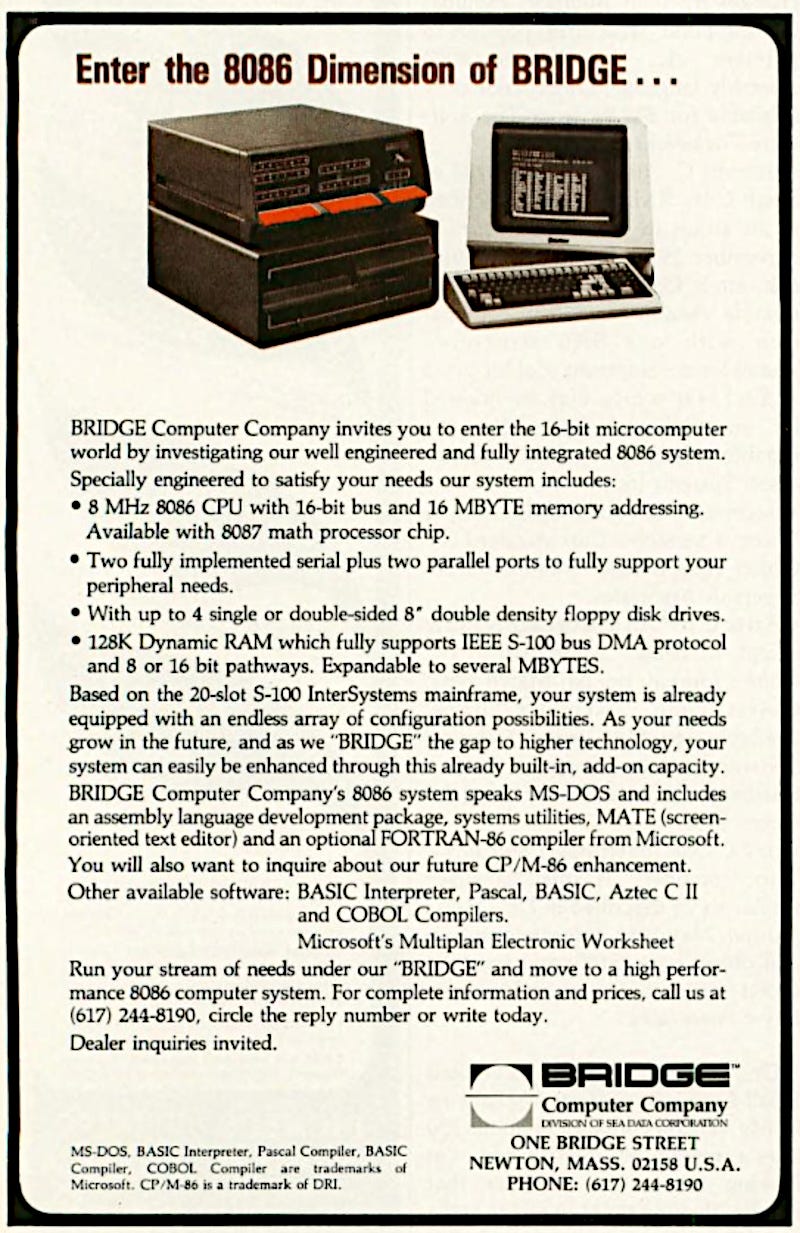
86-DOS (QDOS) didn't exist before 1980, and my 5.25" floppy of IBM PC DOS v1.01 is Copyright 1981, yet the ad from the December 1978 issue of Byte magazine's Copyright/Trademark attribution lists DOS, BASIC, Pascal, and COBOL as registered to Microsoft, yet MS-DOS wasn't released until August 12, 1981 (almost 3 years later).
What initially captured my attention was what in the IBM microcomputer world would later probably be a Personal Computer Expansion Unit sitting atop a 5150 (https://www.computinghistory.org.uk/det/21352/IBM-5161/), and it looks to me like an ethernet switch with ports in the front - I'm sure it's not (obviously), but from the photo that's what it made me think of.
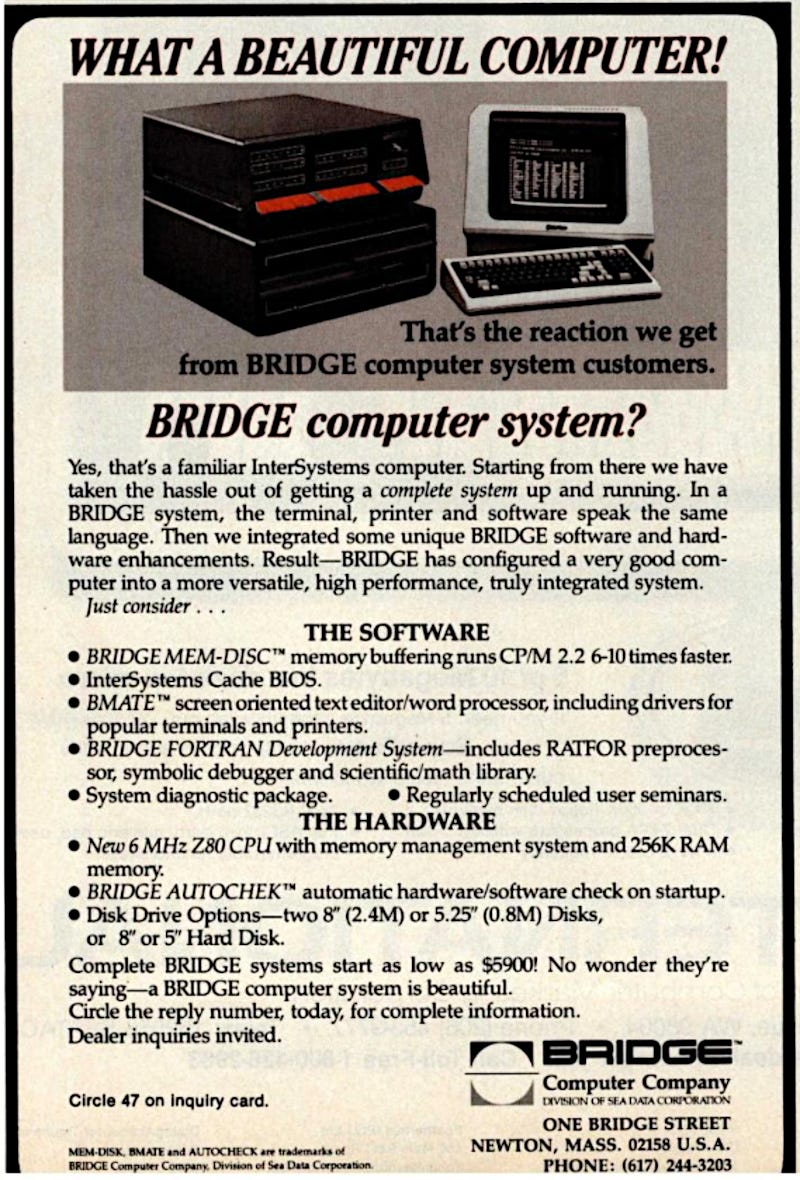
The three ads differ in the content, but the photo of this good looking behemoth is the same across the 3 year span of it's marketing. Really really odd. I suppose the travesty here is that we only have 'some' information on this machine which, for as kewl as it appears to be, ends up without much in the way of anthropological posterity.
Perhaps others will come forward with some tasty tidbits of information on this particular product that didn't seem to change much at all during its retail life-cycle.
Thanks John Paul, I love getting your newsletters and likewise reminisce over historical computing machinery, hoping for better documentation and preservation for this era of (what we called back then) 'data processing'. That's a really kewl find that you've shared with us all there :)
Back in the early days of computing, the sheer number of attempts by companies to be the next big thing is staggering. It was a great time to be alive, even if you could only play with most of them was in stores. :)
Or like I used to play Gemstone Warrior on the Apple 2 before school started using the home-ec Apple IIe :) Man, that was fun...