
ComputerWorld Interviews Lotus' Mitch Kapor (1985)
They discuss Lotus, AI, and Lotus' competitors
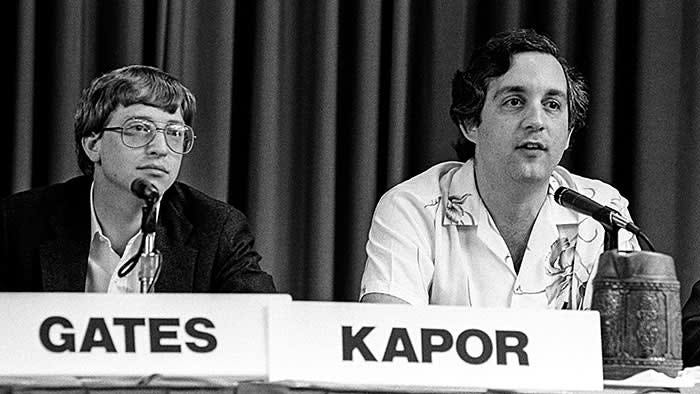
from the July 15, 1985 issue of ComputerWorld magazine
A conversation with Mitch Kapor
“In the applications arena, Lotus is clearly in a market leadership position, and our goal is to stay that way. We expect competition from a variety of sources that may include Microsoft, Cullinet, IBM, two guys in a garage. We can’t afford to be complacent.”
How has Lotus changed in the last year?
First of all, it’s a lot larger in revenue and in head count. We have started divisionalizing the company, which is a very major organizational change. We are much more stable, partly because the micro software industry has shaken out to a large degree.
I think there is a perspective shift: How are we going to climb the next mountain? That’s a question that we weren’t asking ourselves a year ago. We had a one-product-at-a-time focus a year ago. Now we have a focus on growing entire new product lines while we protect the core business. It is a very major shift in perspective, sort of going from a local outlook to a more global outlook.
What’s the focus that ties together the Dataspeed acquisition and the other recent corporate moves?
We are selectively expanding the role that we will play as a player in the information industry, which is to say we will build upon our base as a personal computer software company, in fact as the leading company, to leverage our assets. In other words, what are we good at, and what do we have?
First of all, we have about a million happy customers. So to the extent that we can identi(ify) needs they have that are not currently being served, we can create new applications or new classes of software applications for them. Part of what I’m doing are these textual productivity tools that have some artificial intelligence aspects to them. A number of the development alliances we have made with Jon Sachs, Ray Ozzie and Jerry Kaplan will come out as products.
At the same time, we are going to expand our markets selectively to segments that we’re not serving directly but where our applications and service expertise can be brought to bear.
We identify the engineering and scientific marKet as a clear case where there is about a 20% overlap of customers today, of engineers, scientists and technical professionals who use 1-2-3 and Symphony. That still says that we are in the software and services business, but in an expanded fashion.
What kind of services will become important for Lotus?
Substantially all of the offerings we have today are software products. Although they are products, they come with a high degree of service of various kinds, whether it’s the hot line or the courseware and so on. Our goal there is to have appropriately complete service that supports our products. The [Lotus] magazine is an excellent example of a service vehicle that, by the way, we expect to pay its own way.
I would contrast that with Dataspeed, where the business is a service business. There is a software component — the software that will go on the personal computer to interpret and allow you to manipulate the real-time stock quotes, and we are intending to use our expertise as an application company understanding the needs of end users — but what we are really selling is the service. That is a new kind of offering.
What are the top issues for your corporate customers?
The first thing is to recognize that a corporation that has hundreds or several thousand personal computers requires and deserves differentiated attention from us. Some of it just has to do with the scale of operation. There are logistical issues that need special attention — for instance, upgrades. If you have several hundred users out there and we are doing an upgrade, to force them to go through the same one-at-a-time procedure we would have for any other user doesn’t make any sense. Or where they have an information center, that requires some differentiated treatment and support. So there is just a laundry list of attention to details.
The number two and three issues are protection and licensing, which go together.
We are hearing now a real attitude of extreme reasonableness coming from many individual large customers. I think it has been unfortunate that there have been some very strident voices that have not contributed to positive dialogue.
We are trying to understand how to strike the correct and mutually beneficial and productive bargain, which I think could take the following form — and I say “could” because we have not committed to this.
Protection could be partly contractual. Protection does not, in all cases, have to be encryption on the floppy disk or the equivalent. Large customers understand that in order for us to do business they have to be willing to shoulder some of the burden of responsibility for the usage of the product within their organization.
That comes down to some variant of “if you remove the copy protection, we will agree to be responsible to see that illegal copies are not made.”
A bargain could be struck. But that ignores the subtleties and complexities of the issue, of which there are very, very many.
We are not inflexibly committed to copy protection as some sort of last stand, but we are committed to doing business in a way that we feel protects our economic interest.
We have gradually moved our position, as much as our customers have moved some of their positions. Nobody is going to be in business for a long time if they are not responsive.
There are two things that we won’t do. We won’t walk away from copy protection totally, and we won’t enter into any agreement that allows for unlimited reproduction, which is just not realistic or reasonable.
It’s also apparent to us that if a site license makes sense at all, it will only make sense if there are 500 or 1,000 or some fairly hefty threshold number of machines.
And there have to be adequate solutions in terms of copy protection in all of the other cases.
How is the Adapso technical proposal proceeding?
It is getting closer to full publication. Some very impressive progress has been made in reducing the likely costs of manufacturing these devices. There’s some very innovative technology that is being donated by Apple, which I think is very exciting. There is active involvement by hardware manufacturers of all kinds — Hewlett-Packard, Apple and others that I can’t name. If a protection port or authentication port could be built into a machine that would essentially add zero cost, software vendors and users would have more flexibility.
What’s in it for the hardware suppliers?
Two things. One is that all of these hardware companies are also in the software business, and they can see the effects of software piracy on their software business. Software revenues are going to grow faster than hardware revenues in all segments, including mainframes, and a hardware manufacturer doesn’t want to see its own growth opportunities choked off. Every single manufacturer I have talked to, and that includes the world’s five biggest, has privately expressed its concern with the problem and its commitment to do something about it.
[Another benefit is that] a significant segment, perhaps not a majority, of the large customers that I have talked to see something like the locking key as being potentially beneficial for a variety of reasons.
One is in providing a non-burdensome but more effective means of controlling and administering the use of personal computers and software within their own organizations. The second reason is security of data, which is a very pressing issue in the corporate environment. The Adapso standard itself doesn’t provide that, but it has been very carefully designed to be extensible. For example, add-ons or custom microprocessors that work on the bus could provide data encryption and authentication.
One of the virtues of the [Adapso] lock-and-key schemes vis-a-vis everything that we have today is that it allows a single user to use software on multiple machines and allows a single piece of software potentially to be shared on multiple machines.
What kinds of problems will AI-based software help to solve?
One problem is that the amount of overhead and of thinking you have to go through to get nicely formatted business correspondence is actually too much, in my opinion. It could be greatly simplified.
Another issue: the management of loose bits of information, such as your appointments, a list of things to do, the notes that one may make at a meeting or something about who said he would do what and when — there is no effective organizing tool for coordinating the stray bits of information. There are some individual products like appointment calendars, but those sort of take a piece out of this integral web. They’re very partial solutions.
A third problem is when you have groups of people working on projects over an extended period of time and they build up a heterogenous set of documents. For instance, in developing a software project there are specifications, design papers, weekly progress reports, schedules, correspondence, marketing plans, test site reports, bug reports and other kinds of status reports. These documents are originated by many different people. There is no effective way of coordinating, integrating and querying a heterogenous set of documents on related issues.
The more we look into it, the more firmly we believe that there are these distinct but overlapping problems with management of fundamentally textual as opposed to numeric information and that one wants to apply personal computer technology to those problems.
What do you think of Steve Job’s statement at a Microsoft press conference in May that “there’s a war brewing between Lotus and Microsoft?”
I think wars are fought between armies of nations. There is no question that in the applications arena, Microsoft attempts to compete with Lotus. That is intentional phrasing, because in the applications arena, Lotus is clearly in a market leadership position, and our goal is to stay that way.
We expect there will be ongoing competition from a variety of sources that potentially include Microsoft, Cullinet Software, IBM, two guys in a garage. Competition can come from other micro software companies, from start-ups, from multi-billion-dollar hardware companies. We simply can’t afford to be complacent at all. It is really hard to say right now where the major threat is going to come from.
We have to maintain our own internal sense of balance and appropriateness. That means making good on the commitments we make to our customers, shipping the new products that are the ones that people want and logically continuing to build up our business.
When I get up in the morning and I ask what we are doing, my first thought is not how we are going to beat the competition; my first thought is what are we going to do for our customers. I know it sounds a bit like a homily, but it happens to be the way I think, and it’s the way that Lotus thinks. It’s a good corporate style. It is OK for [Atari’s] Jack Tramiel to say that business is war, but I say business is making customers happy.
Is Lotus starting to move into systems software, for example in the Lotus/Intel expanded memory scheme?
In a strict sense, memory management being a function of the operating system, one could say the Lotus/Intel spec sort of crosses over into the operating systems arena. However, it is a major tactical move, not a strategic move, because it is intended to respond to a very particular set of customer needs, spreadsheet users who want to have more memory in their models. Because a more general solution was not forthcoming in the time frame the customers wanted it, we really felt it was incumbent to do something about it. The lack of generality of the spec is its strength, because it sends a very clear signal that it’s for data, not for code. It really works well for spreadsheets but may not work for other things. It is also clean; it doesn’t screw up the operating system. The nature of the specification itself says something about our intentions, which are not to go into the systems software business in a general fashion.

What computer ads would you like to see in the future? Please comment below. If you enjoyed it, please share it with your friends and relatives. Thank you.