
CP/M Review Interviewed William Godbout, Founder of CompuPro (1984)

From the January/February 1984 issue of CP/M Review magazine
Conversation with a Pioneer
by Mike Prezbindowski
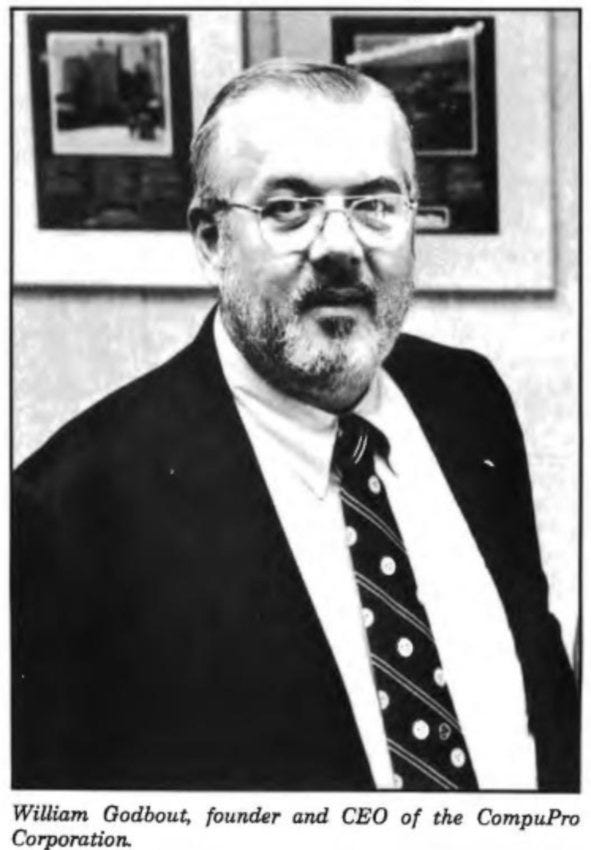
William Godbout is the founder and Chief Executive Officer of the CompuPro Corporation. CompuPro is one of the oldest computer companies in our uncertain industry, and Bill relates to us some of his background and business philosophy that has enabled them to survive, in fact flourish since 1973. CompuPro evolved from some Godbout companies that manufactured kits and S-100 components to a corporation that offers an impressive line of complete computer systems. They haven’t abandoned S100 or board products, in fact they are offering STD Bus products and are considering new bus products. A large segment of their market is industrial based and they have large OEM accounts in the United States and Europe. You may be using some CompuPro products and not know it. While not an overnight giant, they have been continually building a strong base of support and have consistently offered products known for their reliability. Mr. Godbout has been a force in the development of the microcomputer industry.
CP/M REVIEW: Bill why did you start your own company?
Godbout: I had to have a job! Something to keep me off the streets and out of jails. Actually, I have been involved with computers in one way or another since college.
CP/M REVIEW: What did you do after college?
Godbout: I was recruited by IBM while in undergraduate school at MIT. At IBM I participated in the development of such machines as the 704’s, 705’s and 709’s and worked on the team that did the “90” and the “STRETCH” machine. (The “STRETCH” was so named because it stretched the capability and technology of their company.) I was then recalled to active duty with the Army diming the Berlin crisis.
CP/M REVIEW: Since you’re from the East Coast, why did you start your company in the Bay Area?
Godbout: I had been to San Francisco several times and it looked like a nice place to spend a couple of years. Also, the opportunity arose to take over a foundering company as a crisis manager for a period of 24 months. I started as manager of systems development and left 13 months later as general manager.
CP/M REVIEW: Then you have had business training also?
Godbout: I don’t want to say I’m just an engineer, I’m not just a “technocrat.” While at IBM I had extensive management training. When you go to work for IBM, your management training starts the day before you go to work for them, when you are selected for employment and accept their offer. You get, directly and indirectly, a good orientation. IBM is a very well managed company. If I were to work for someone else, my first choice would be IBM.
CP/M REVIEW: IBM seems to be a very conservative company. Only in the past 2 years have they increased their presence with the marketing of the Personal Computer. In the small computer market CompuPro seems to be a bit more conservative than other companies. Is this because of your IBM background?
Godbout: IBM is not as conservative as you think, they have gone out on a limb many times while pursuing various market segments. The “STRETCH” machine, like many of the products they brought out, was great for its day and even today would be no slouch. Many of the things we take for granted were way out in the ozone back then; interrupts, memory management, multi-programming, dual CPU’s, all came from that project. The IBM 7030 (a 72-bit 200 nanosecond machine) for its day, was a marvel; it was a bigger leap forward for technology than a “STRETCH” to a CRAY-1 is today. It was the first of IBM’s second generation computers. They started the project in 1955. It was re-designed in ’58 and got out the door in late 1960. 1 think they built six of them. Everything was being done with dual triode tubes and IBM had to design and manufacture its own transistors in order to build this machine, there was semiconductor core memory with interleaved memory cycles because the cycle time was only 2.2 microseconds. But they brought it down to 2.0 and finally 1.8 microseconds. The same memory boxes were used later on the 7090. All of the packaging concepts for the 7000 series came out of the “STRETCH” project.
Then RCA announced they had 5 billion dollars to commit to the computer business from the monstrous sale of TV sets in the mid to late fifties. RCA had this big cash bubble and the computer business looked like the way to go. At the time RCA announced its intent to throw this amount of money into computing, IBM had I not even had a billion dollar year. That takes guts and entrepreneurial spirit. It takes real management to pull off something like that. I admire IBM and think highly of them as an employer, an entity, and as a competitor. Because at some point we are going to come head to head, I hope.
CP/M REVIEW: Do you think there is room in the marketplace for all the now existing computer companies?
Godbout: Obviously, IBM and the others are not all things for all people. There is a nice hole where IBM has been spectacularly unsuccessful. IBM’s share of the low end minicomputer market is only 4 percent compared to 80 percent on mainframes.
CP/M REVIEW: Does the background and experience of CompuPro give you any advantages in this area of the market?
Godbout: While other manufacturers such as WANG, IBM and DEC have entered by the back door into the micro fray simply by putting CP/M onto existing machines previously dedicated to word processing, we at CompuPro have historically only offered CP/M on our equipment. This gives us a definite advantage.
CP/M REVIEW: CompuPro’ s recent emphasis on the business market will require a good service network. Has the ground work been completed in this area?
Godbout: We have an agreement with XEROX called AMERICARE, for CompuPro system level products. This opens up the market for our S-100 and non-S-100 systems, and offers new potential in the business and scientific markets.
CP/M REVIEW: How is XEROX gearing up for this task?
Godbout: XEROX has been sending their people to us for technical training on repair of CompuPro machines. We have also trained their instructors. They have assigned 300 to 400 technicians to our account which means that there will be 3 to 4 trained technicians at each XEROX service center. We do not want them to go to a customer’s site and wave soldering irons around. Each location will have several different sets of spares and will only do modular replacement to minimize down time, not component replacement. With the introduction of the CompuPro 10 aimed squarely at the business market, it becomes essential that we bundle a service package with that system. This feature has been added without increasing the overall system price on both our S-100 models and Model 10.
CP/M REVIEW: Do you plan to stay with Digital Research in the near future, with the popularity of UNIX becoming so widespread?
Godbout: We have been asked numerous times why we don’t support UNIX on the 68000. We have looked at it and have not found any implementation that we liked; we do not feel that the 68000 has enough horsepower to handle a true multi-user UNIX configuration. Bell Labs currently has a CompuPro system prototype using the National 16032 CPU and is porting UNIX for us. We will be showing it at the 1984 NCC.
CP/M REVIEW: Will the addition of UNIX affect your relationship with Digital Research ?
Godbout: DRI has got their act together and has become a real force in the marketplace. Creative Strategies, a marketing research company has predicted that by 1987, 49% of the market will be using UNIX and 37% Concurrent CP/M. I think we will still have an excellent relationship with DRI.
CP/M REVIEW: How has CompuPro been doing as a company in the marketplace?
Godbout: The market share of CompuPro today is 1.3% of the total according to a survey completed by Data Solutions. This tallys closely with other market surveys. This figure puts us ahead of such companies as Alpha Micro, Fortune and Franklin. Where we really show up well is in surveys that show “brands under consideration.” There we show a 4% share. These are surveys using open ended questions and not mentioning the Model 10 which hadn’t been announced at the time, only CP/M S-100 systems. This puts CompuPro in direct comparison with DEC and other major manufacturers of computers smaller than mainframes.
We are pleasantly surprised at the statistical significance. We expect the model 68K, “10” and 16032 to cause quite a commotion. We do want to say for the record that the Japanese home market is safe at this time; we have no immediate plans to sell in Japan.
CP/M REVIEW: How are your products being marketed in the United States ?
Godbout: We have a strong dealer network with close support. A strong dealer network is essential if you are to move from “Smalltown, Iowa,” to “Backwoods, Maine.” You must be in striking range of a dealer that will provide service, sales and support--with a smile.
CP/M REVIEW: I understand CompuPro had a role in establishing the IEEE 696 standard, could you tell us about that?
Godbout: The Chairman has always been an employee of CompuPro or an affiliate. George Morrow was designing for us when it started.
I personally did not have the time to be directly involved. Mark Garetz was chairing when the standard was completed; in fact, he typeset the whole thing.
CP/M REVIEW: Did CompuPro’ s involvement in the process directly benefit the company?
Godbout: If you mean did we control the steering of the committee, NO! The committee was put together to hammer out a consensus. The result is definitely not a CompuPro standard. I got a few things I wanted as did every manufacturer that reviewed the specs. But no, I was all for making the bus active low so when you let go of the bus nothing would happen. The DMA transfers, Ithaca Audio did that, Marinchip did the 16-bit memory and peripheral swap idea. Howard Fullmer from Parasitic Engineering had a lot of good input.
A funny sidelight to that. Before the S-100 subcommittee was formed a physician named Bill Shander and an instructor from Diablo Valley College decided in 1976 to have a meeting of manufacturers and end users. IMSAI, Altair and Processor Technology, to name a few, didn’t bother to send representatives. All the attendees are still in business today. The non-attendees were either too busy or couldn’t be bothered.
CP/M REVIEW: What are the most significant markets for CompuPro?
Godbout: S-100 products continue to be a major sales item for us. Mullen Electronics has become a partially-owned affiliate of CompuPro and is handling much of our STD bus market. Mullen is mainly involved in the industrial marketplace. They came under our wing after an unsuccessful venture into the Radio Shack market.
CP/M REVIEW: Is the STD Bus product line a new venture for CompuPro?
Godbout: We have been supplying memory boards and CPUs for the STD bus since day one. Rick Kalish, a member of the IEEE committee working on standardization, works for us. We will continue to support this market and Vector Electronics will be involved with us. We do not plan to drop out of the industrial market-we plan to get bigger.
CP/M REVIEW: You mentioned Vector Electronics involvement in this venture. What is the relationship between Vector and CompuPro?
Godbout: We have just completed an agreement with Vector Electronics to provide second sourcing of CompuPro products. Vector is a well-established company with many years of experience in the manufacture and packaging of electronic products. They have a large industrial distribution network in place and serve pegboard customers as well as the Fortune 500 companies such as Bell Labs. Any firm using electronics is probably familiar with the Vector name.
The second source market is aimed at the third-tier products where the computer is actually a subsystem and the end product may have a design cycle of 18 to 20 years. This allows CompuPro to maintain its leading edge position with regard to technology while assuring manufacturers that products they design today will be available tomorrow. As CompuPro products are phased out of production, Vector will pick them up if the market warrants. British Telecom is one example; they use our products in their stock quote system which was years in development. They just ordered 1000 boards with more to come. The same distributor in the U.K. will serve as second source for Vector at the time we switch manufacturers.
CP/M REVIEW: Is Vector capable of maintaining the level of quality you build into your products?
Godbout: Vector is a fully integrated manufacturer, from laminates through punch, plate, drilling and soldering. The Vector S-100 motherboard is a Godbout design built under license by Vector. We have the utmost confidence that the level of quality inherent in CompuPro products will be maintained by Vector.
CP/M REVIEW: How long have CompuPro and Vector enjoyed this working relationship?
Godbout: Vector has had a good working relationship with Godbout for years. There is a high level of technology transfer between the two companies. Their engineers are on a first-name basis with ours and communicate regularly. A channel for technology exchange exists and is used frequently, and is encouraged.
CP/M REVIEW: Will the Vector computer line continue to grow in the future or will it be limited to a few products?
Godbout: Vector and CompuPro will move ahead together, as CompuPro moves out of one product line Vector will pick it up as the market warrants. CompuPro is the first company to offer second sourcing in the micro business.
CP/M REVIEW: What does the future hold for Bill Godbout and CompuPro?
Godbout: Just over the horizon at the other end of the spectrum is the 32-bit machine. It poses a problem. Take, for example, the NS 16032, the CPU has a 16-bit bus and is double pipelined. Compare the Intel 8086 and 8088, one has a 16-bit bus and the other an 8-bit bus. The 8088 shows remarkably similar performance to the 8086 despite the smaller data path. This is due to its pipelined architecture. The 16032 benefits similarly and should not lose much when compared to a full 32-bit data bus.
We are currently working with Intel to clean up some things on the apx-386. It is a full 32-bit virtual machine that is upward compatible with its 8086-based predecessors except the 64K memory segment limitation has been removed.
CP/M REVIEW: CompuPro has been mainly an S-100 company. How will you develop 32-bit machines for the S-100?
Godbout: The S-100 concept works fine for 8- and 16-bit, but doesn’t hold up to the 32-bit processors. The obvious temptation is to multiplex some of the address lines to gain the needed extra data lines, but the reduction in bandwidth makes that an unacceptable technique. Probably, 32 bits is the point where we will have break with S-100 and move to a VME-like bus. There currently is no VME bus standard and we may get involved in that area.
During grad school at Cal Tech, Tony Pietsch published in the proceedings of the IEEE a proposal called the PI bus. The VME is a takeoff of this. The thing that fires my rockets is that they didn’t even acknowledge the source. It may be in their ignorance they didn’t know where it came from, but the marked similarities are too great for the PI bus not to have been the lineal progenitor of VME. It sure would not have hurt anybody to acknowledge Pietsch’s contribution which was put into the public domain.
CP/M REVIEW: Most of the more sophisticated buses seem to drag the performance of their CPU’s down with a lot of protocol. Will the PI bus also do this?
Godbout: The VME bus does restrict the computer’s overall performance, but the PI bus, on the other hand, allows maximum performance.
CP/M REVIEW: Your philosophy regarding mixing CPU’s in an S-100 system is novel and useful. Will this also be carried to your 32-bit machines?
Godbout: We will make available some sort of 8- 16- to 32-bit interface to allow slavery of these processors in future 32-bit machines, it may be through a converter from an S-100 to a future bus.
CP/M REVIEW: CompuPro has not jumped into the networking market. Are you planning to, and with what type of protocol?
Godbout: We plan to offer several types of networking options. There is currently chaos out there. We are looking seriously at Arcnet as it is a proven technique with an existing chip set. The CompuPro 10 has a SASI interface in the back and there are several SASI to “garbagenet” interfaces already are on the market. We will be making a product for the Model 10 that will be a hardware/ software package. It will have two interesting ends. The obvious is the Model 10 end and the other will go to an IBM PC, S-100 or another CompuPro 10. You can do any combination or permutation you want.
CP/M REVIEW: The choice of Datapoint’s Arcnet bucks the tide of support that the other manufacturers are giving Ethernet. Why do you think Arcnet is better?
Godbout: It turns out that Arcnet provides better bandwidth and overall system performance than Ethernet. The reason for that is there is an awful lot of system overhead associated with Ethernet. Although Arcnet has half the stated bandwidth, it runs at least as fast or faster in a comparable context. Sure, you’re shoveling data at 5 megabits instead of 10 megabits per second, but the overhead on each of the nodes is so significantly less for Arcnet that the overall throughput is of a networked system is much greater. With Ethernet, the data coming through the node slows down processing on the node while it figures out if any of the data should be received or not. I find this unacceptable. At this point, Arcnet is the front runner and we are looking at several others.
CP/M REVIEW: Does CompuPro have a long range plan to help assure its continued growth and survival?
Godbout: We are definitely a growth company, not a hit-and-run company. Ten years ago we started with Compukit and MusicKit. We do not intend to rush into the public market with a take-the-money-and run business plan. We would rather establish a long-term business. We are definitely in it for the long haul.
We are not ruling outgoing public, we just aren’t to the point where we have optimized profit and timing yet. Why grab a few 10’s of millions when in five years we might knock off a couple of billion? We are fortunate that the company is solid and stable. We have had steady planned growth. I think it is obvious, if you look at our moves, that our products didn’t just happen. Several business analysts have looked at our advertising and our products, and have noticed that over the past ten years the planned mix of products pulled together with phased growth.
CP/M REVIEW: Is there any outside venture money in CompuPro?
Godbout: We have no outside money, and therefore no pressure from venture capitalists who would require a money turnaround in five years. The Godbout Company is the venture company for CompuPro. The Godbout Company is involved in with many things--some not related to Electronics-mostly long term, such as an automated test equipment company and software companies. We do not intend to abandon the S-100; it’s becoming more like the IBM stuff-well rung out and very solid. We find that there are a lot of companies just now considering designing microprocessors into their control systems. We who are on the cutting edge of technology sometimes don’t realize how industry works out there. They have barely caught up with the Z80. Look around at the products coming out now using Z80’s and 68000’s, machine tools and automotive applications. The S-100 still offers a lot of flexibility. There is a lot of industrial interest from such areas as the Army, Navy and Air Force, and a full 50% of our business comes from OEM’s and component accounts, a continuing growth market.
CP/M REVIEW: Earlier you referred to European customers. Has CompuPro established overseas distribution?
Godbout: We have Comcen Technology in Wales, and they have offices in London as well. They are our European distributors just as Byte Industries is our United States distributor. We have also established a Distributor in Australia called Automation Stratham.
CP/M REVIEW: Is the S-100 still performing well from the product marketing point of view?
Godbout: It is still ahead of projections in terms of product growth. The S-100 is really just starting to come into its own. The new products that promise more power and speed will only add to the growth potential of an established design, now that the industry is recognizing it as a stable and rung out standard.

What computer ads would you like to see in the future? Please comment below. If you enjoyed it, please share it with your friends and relatives. Thank you.