
Cromemco C-10 Personal Computer
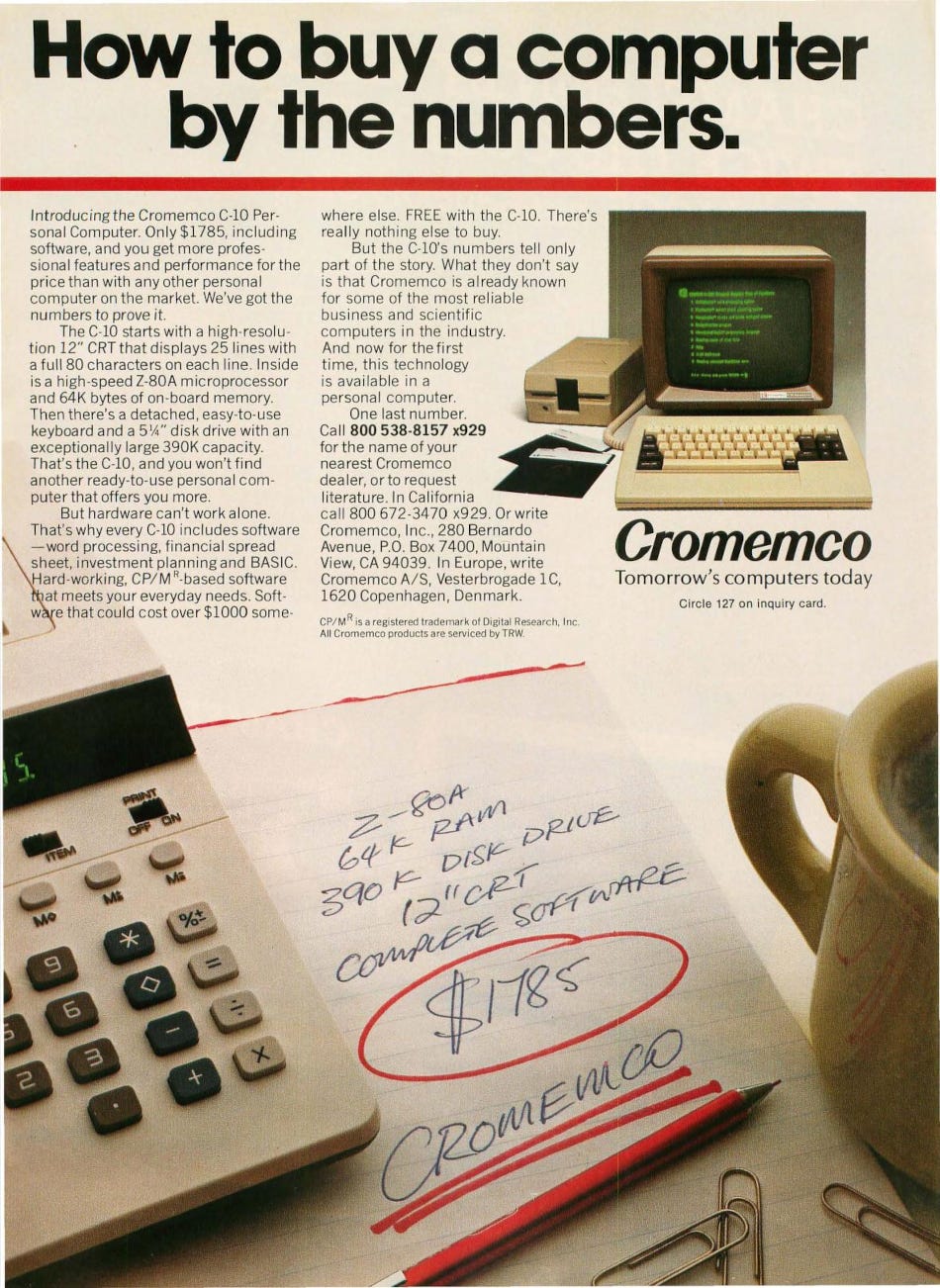
How to buy a computer by the numbers.

The Company
I covered the history of Cromemco in a previous post about the Comemco Z-2D.
The Computer
Cromemco’s initial systems were more business-focused. In the 1980s, there was a growing demand for personal computers. In 1981, IBM released the IBM Personal Computer. Comemco decided to jump on the bandwagon and released the C-10 in 1982. This was Cromemco’s only entry into the PC market.
The C-10 has the following specs:
Zilog Z-80 4MHz procession
64K of internal RAM
24K of internal ROM
Cromemco enhanced CP/M
High-resolution 12-inch CRT
RS232 serial datacommunications port
Parallel I/O expansion and printer port
Serial printer port
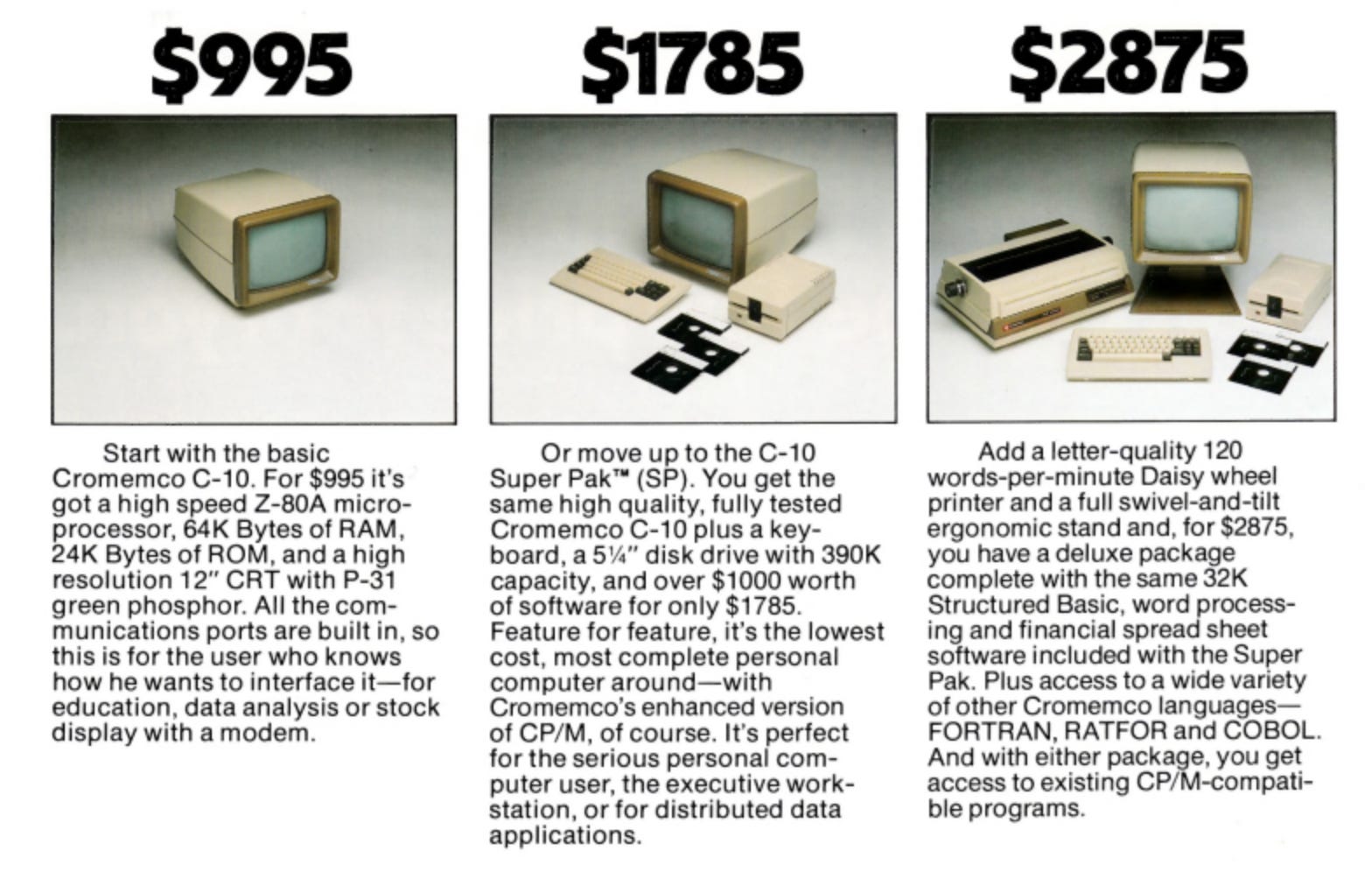
This system was available in three different packages:
The basic package included the C-10, a detachable keyboard, and a 390K disk drive for $995.
The “Super Pak” (I also saw “Super Pack”) added $1,000 of professional software, including “a word processor, an investment analysis program, spread sheet calculator, and Structured BASIC” for $1,785.
For an extra $1,000, users would also get a Daisy wheel printer, an ergonomic stand, and “access to a wide variety of other Cromemco languages—FORTRAN, RATFOR and COBOL”.
One of the earliest mentions of the C-10 I found was in the August 1982 issue of Electronics Today International.
The Marketing Manager of Adaptive Electronics, Mr. Adam Gatt, says that the Cromemco C-10 is perfect for the serious personal computer user, for the executive workstation, for distributed data processing or as a front end for a mainframe computer.
Starting at US$995, the new C-10 is based on the industry-standard high-speed Z80A microprocessor and has 64K of internal user-accessible RAM and 16K of internal ROM.
The C-10 comes with an integral intelligent high-resolution 12-inch CRT with a detachable, light and easy to use keyboard. It also has a wide range of peripherals available, including floppy disk drives and a new low-priced (US$895) letter-quality daisy-wheel printer.
Mr. Gatt envisages that the most popular configuration for the C-10 will be the special Super Pack, referred to as the C-10SP. This system configuration consists of the basic C-10, keyboard, 390K capacity 5%” floppy disk drive, along with a CP/M-compatible operating system, 32K structured BASIC, word processing and financial spread sheet software.
Besides access to the entire range of other Cromemco products (such as FORTRAN, COBOL and RATFOR), because of its CP/M compatibility the C-10 gives the user access to the widest possible range of microcomputer software products available.
The Australian computer magazine Your Computer published a review of the C-10 in their April 1983 issue.
Things are really rocking at the bottom end of the personal computer market - the under-$3000 machines with word-processing and spreadsheet capabilities. In the months AO (After Osborne), the market niche which that luminary found for himself has been invaded - in Australia, at least - by first Kaypro, then Morrow Designs, and now Cromemco, with the C-10.
The C-10 is a pretty little computer, designed to sit neatly on a corner of an executive’s desk. The main electronics and the screen are in a small moulded plastic cabinet, which is designed to sit atop a tilt-and-swivel stand. Attached by cables to the rear are a small keyboard and a single 13 cm disk-drive.
The machine is finished in two-tone brown and looks fairly friendly and neat, with a minimum of cables.
The display is 28 cm on the diagonal and is clear and easy to read. It features half-intensity, underlining and inverse video, as well as special symbols and chunky and line graphics. The screen-driver software emulates a Cromemco (Beehive) terminal, providing 80 by 24 display with a 25th status line, though this is normally switched off.
Intended to take up as little space as possible, the keyboard is compact yet ergonomically designed. It features all the usual characters and control keys, with the exception of a numeric pad, though one section of the keyboard can be re-programmed to provide that function. The keys have a soft action, and feature moulded keytops.
...
The innards are based on the Z-80A processor, with a 4 MHz clock and 64 Kbytes of memory. The basic design is not expandable - there is no bus structure - and is specifically designed to provide the functionality of an executive workstation.
The overall quality of construction is good; the box feels rugged and reliable. Because of its design, the machine can’t be described as portable, but it is light enough to carry and move around from location to location.
...
On power-up, the C-10 performs some diagnostics, and then boots off disk. The operating system is Cromemco’s CDOS, which is a modified upgrade (and descendant) of CP/M version 1.4. However, the first-time user is not immediately exposed to the rigours of the operating system. Instead, the system brings up a menu program which allows the user to specify what he wants to do.
...
WriteMaster belongs to the “What You See Is What You Get” school of word-processing. Text entry is much like on a typewriter - automatic wrapping at line endings is an option - so most users will hear the bell sound as they near the end of a line, indicating that return must be entered soon.
...
A feature I particularly liked is that parameters like varying margins and tabs are automatically saved with a file: that’s something WordStar won’t do for me.
PlanMaster, Cromemco’s financial analysis program, is similar to VisiCalc in its fundamental concepts, but has some significant differences.
First, the spreadsheet is not as large, and is organised somewhat differently: there are 10 pages, each with 30 rows of 12 columns plus row and column totals. Rows and columns may be labelled, with labels appearing in formulae.
An unusual facility is the ability to display numbers in hexadecimal format I’m not really sure why you might want
to do that, but then again it could be useful for working out memory maps or some such application.
...
The programming language supplied with the C-10 is Cromemco’s Structured BASIC. This is a large language with many advanced features, such as matrix initialisation, degree mode for trig calculations, and advanced control structures such as WHILE/ENDWHILE and REPEAT/UNTIL.
...
Other software supplied with the C-10 as standard includes a chess game which plays to a high standard and puts the C-10’s graphics to good use, and the usual selection of machine-specific utilities.
For programming in languages other than BASIC, a screen-oriented editor is supplied which is similar in operation to WriteMaster, but writes pure ASCII files, without any of the formatting information used by the word processor.
...
The documentation supplied with the system is excellent. The manuals are produced to a very professional level, and are intended for the first-time user. However, one area which I felt could have been more prominently covered was the initial copying of the system diskette, a task which most neophytes approach with considerable trepidation.
The only area not covered in depth is the CDOS operating system itself, though the CDOS manual is available as an extra.
Overall, the Cromemco C-10 scores well as a professional, personal workstation or small business computer. It has good software support from Cromemco, and can, of course, run a goodly percentage of CP/M 2.2 software. Though built to a price, the quality doesn’t seem to have suffered.
Australian Microcomputer Magazine briefly mentioned the C-10 in the “Hardware highlights” section of their April 1983 issue:
The Cromemco C-10 is atthe bottom end of the Cromemco range of computer systems. The machine is a personal computer, with good communications facilities, built to the austere and reliable standards that are the strength of Cromemco machines.
…
It should prove popular with users of large Cromemco systems as an intelligent terminal and standalone personal computer. Retail price from most Cromemco distrubutors is around $A2300 before tax.
Mike Hughes wrote a review of the C-10 for the June 1983 issue of Practical Computing.
The C-10 is being sold as an integrated package of hardware and software attractive to non-technical users. It is designed to offer the administrator or secretary a device which will assist them at work in much the same way as a calculator is used by accounts staff. The packaged software reflects this approach, being simple to use and well documented for a limited range of applications. It is not being sold as a high-technology system which might require technical expertise.
Yet these restrictions only come about from the way the system is being marketed. The C-10 has considerable potential for more sophisticated applications should the need arise. The operating system is basically CP/M with its unfriendly, albeit powerful, aspects cleverly hidden from the user by a menu-driven suite of programs. Word processing, financial planning and the ability to write ones own software using structured Basic are all included. Those with a knowledge of CP/M and the wide range of software available under it will be pleased to know that the system is capable of running most CP/M proprietary software in the conventional manner.
…
The three components of the basic system are housed in lightweight cream plastic cabinets. The display unit houses the CPU, a 12in. green display of 25 lines by 80 characters, and power supplies. At its rear there are sockets for the disc drives, keyboard, printer and communications, and a mains switch.
Conspicuous by its absence is a control to adjust the display intensity. By carefully reading the manuals I discovered that intensity is software controlled. Minimising the number of controls to protect against knob twiddlers is a good thing, but display intensity is a very personal choice and should be easy to operate.
The keyboard is of standard typewriter layout with mechanical alpha lock. The keys that will be unfamiliar to the average typist are Escape, Control and the four cursordirection keys. In many respects the initial impression of the keyboard is that it is more friendly than some of the more modern conventional typewriters. It is extremely light in weight, and connects to the display unit via a four-way self-coiling lead terminated in a standard American telephone jack connector. When extended, the lead allows the keyboard to be positioned anywhere within about 1.5 metres of the display. Unfortunately the featherweight keyboard does not have sufficient “stickability” to combat the recoil effect of the self-coiling cable when used on shiny desks.
…
The standard package of software is provided on a single disc, and a blank disc is also provided to allow the user to make an immediate back-up copy. The description of the hardware, operating system and software is contained in four very nicely presented manuals. Great care has been taken to make these easily readable by the non-technical user, and to keep them simple very little is said about the hardware, something of a frustration to your reviewer.
…
If you look at the system purely as an integrated package to perform office functions it is, perhaps, better to accept the fact that the hardware is neat, attractive and eminently straightforward to put together and get up and running, to provide the benefits of standard software as run on this configuration. Of the three major programs Write Master is clearly the one that most users will have the greatest need for. It is Crememco’s own word-processor package and has been designed to be simple to use. While having to make use of a standard keyboard it keeps the number of multi-stroke commands to a minimum.
To meet this requirement the top row of keys on the QWERTY keyboard are used in Control and Shift-Control mode to perform the more common word-processing commands like Scroll, Move, Copy, Insert, Delete, Centre Text, Print, Underline, Select Block, etc. There is a self-adhesive overlay showing these functions to stick above the keyboard, designating the function of each of the top-row keys in either Control mode. The less common and more complex functions are entered in free text or as abbreviated forms after a single press of the Escape key. After a little practice it becomes surprisingly easy to remember the commands. The user simply has to type in what needs to be done in full or using abbreviated mnemonics. For example, Escape followed by “underline selectedtext” does just that, or Escape followed by “find XXXXX” will find and mark all occurrences of the phrase “XXXXX”.
…
Conclusions
• The Cromemco C-10 is an attractive, friendly little computer.
• Without impairing its ability to run under standard CP/M the operating system and its integrated software provide low-cost word processing and management assistance for an office which lacks technical or computing experience.
• The price is reasonable, though it does not include the printer, and in all but the most trivial applications it is likely that a second disc drive will be required. A two-disc system with printer will cost between £2,000 and £2,500 — still quite viable, and cheaper than most dedicated word processors.
• The user manuals are clear and simple to understand but, perhaps, at the expense of providing sufficient information about the machine for more sophisticated applictions.
• The Write Master word-processor package is excellent in operation, attractive to use and comparatively easy to learn.
• The C-10 is a good buy for someone considering their first steps into the automated office.
The New Zealand Bits and Bytes magazine summed up their review like this:
Advantages: Compact, robust and reliable. Good screen clarity. Good disk capacity. Excellent documentation. Wide range of business software supported. User friendly.
Disadvantages: CDOS limits transportability of CP/M.
Comments: Cromemco is one of the longest-established microcomputer companies in the United States and has a reputation for keeping up with the state of the art. The C-10 represents good value for money.
Typical User: The C 10 would appeal to the small businessman or professional person who requires a database, financial modeller and word processor.
In 1984, Omni Publications published a catalog of available computer hardware and accessories. This is what they had to say about the C-10:
The Cromemco name is not as widely known to the personal computer user as it might be, largely because a fair percentage of the company’s products are sold to original equipment manufacturers for incorporation into other products. But the C-10 is highly regarded by engineers and others who require math and scientific applications. It is being used by the Wall Street Journal, the Chicago Mercantile Exchange, and the United States Air Force. The C-10 cannot be a toy with references like those, or with the backing of a company whose pedigree is as respectable as Cromemco’s.
Cromemco is the oldest company in the United States dedicated to the design and manufacture of microcomputers. It was founded in 1975 and incorporated the following year. Cromemco engineered the first color graphics adapter for a microcomputer, worked on the development of the S-100 bus, and developed both the first 8-inch Winchester hard-disk drive and the first 5 1 /4-inch floppy-disk drive for micros.
The C-10 is Cromemco’s first low-priced computer.
…
The operating system and indeed the entire user interface system is designed for the first-time user. Cromemco is reported to have good support services, and their machines are serviced by TRW nationwide as well. The operating system, a version of CP/M, is menu-driven and all programs and utilities are on the system disk. The system recognizes the user’s configuration— when one adds additional disk drives, the system automatically changes the directions to the user to reflect that addition. The use of CP/M means that most popular programs, like SuperCalc and dBASE II run on the Cromemco.
…
In addition to being a quality personal computer at a very reasonable price, the C-10 can act as an intelligent workstation in a multitasking, multiusing environment. There is a great deal of talk about 8-bit versus 16-bit CPUs. For many users, an 8-bit processor is lazing along when performing the most complicated tasks they can assign it. If one needs massive amounts of speed, however, the C-10 can be tied into Cromemco’s giant System 68000 through the RS-232 port. It can work as a stand-alone, and upload or download within the 68000/CROMIX context.
…
The Cromemco C-10 is a good choice for someone getting started with micros. Its ease of operation, its reasonable price, its ability to be tied into a powerful network, and its manufacture by an established company recognized as a pioneer all should provide the user with assurances of quality and satisfaction.
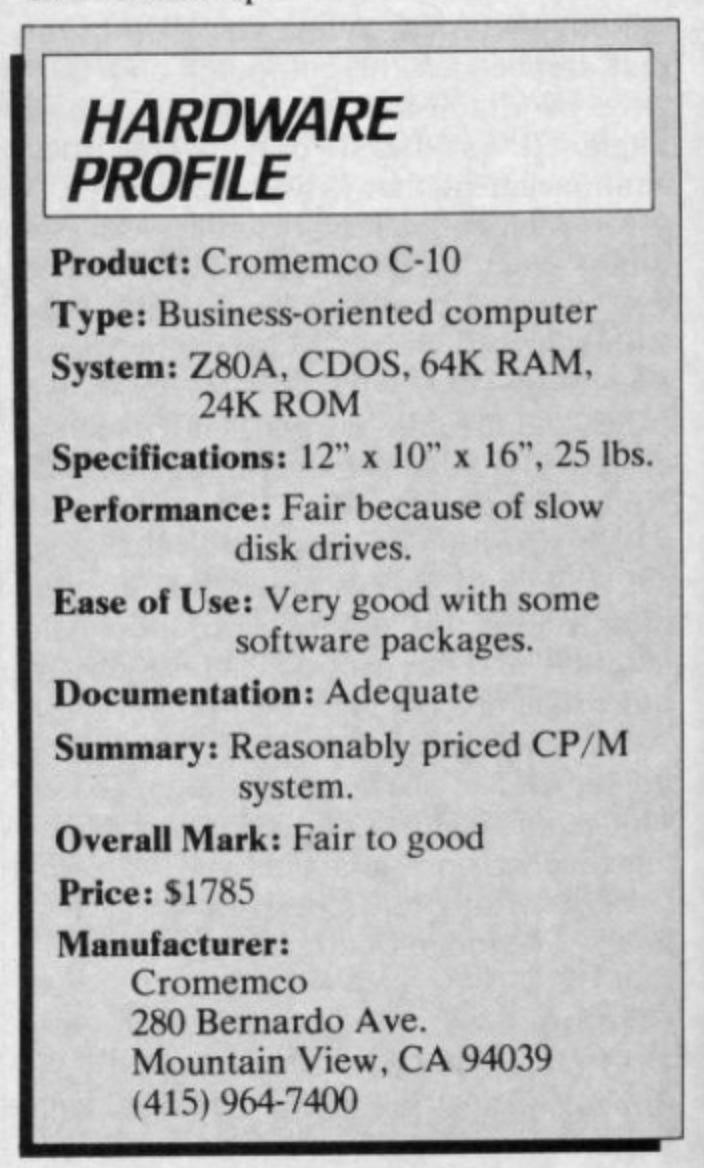
Dave Hilton wrote a detailed review of the C-10 for the 1985 Creative Computing Buyers Guide. Here is his conclusion:
The C-10 is a mixed bag. I gathered the information for this review over three months, during which time I was given four releases of the operating system and two different C-10 computers. Why so many changes? Because I was getting all sorts of strange results from the system. Many times while using WriteMaster and PlanMaster, the system would hang, hit the System Trap, garble and display, destroy my file, or retrench to some lower level of code on the operating system.
I did observe steady improvement through the later releases of the software, but I cannot ignore this general instability in the system. I do not nor do the people with whom I have spoken at Cromemco know just how many of the problems I experienced are bugs in the software and how many are attributable to hardware failures. Certainly, the latter part of the review process, after the original system had been replaced, went much more smoothly than the first part.
As far as I am concerned, WriteMaster is almost reason enough to buy the machine. Structured Basic and the Screen utihty offer the user who wants to write his own software enormous power. For these people, an assembler and additional languages are available as extra cost options.
It is a shame that PlanMaster falls so far short of the quality of the rest of the system. It is definitely the poorest program in the package.
The C-10 is also in desperate need of communications software, not only of the modem hookup variety but of the system-to-system-through-serial-interface-variety. I sat here for over two months with four other computers within arm’s reach and several hundred floppy disks and tapes full of software but no way to get any of it into the C-10.
Conclusion
When I was a little tyke, one of my favorite stories was “The Little Engine That Could.” I thought of it as I watched one of the high-resolution graphics demos on the C-10: a train was chugging its way across the screen with smoke pouring from its stack and the whistle blowing. It occurred to me that the C-10 is like that little train ... if it could just throw off some of the dead weight and get up a little more steam, it could make it to the top.
Have you ever used any Cromemco products? Tell us about it in the comments below.

What computer ads would you like to see in the future? Please comment below. If you enjoyed it, please share it with your friends and relatives. Thank you.
This was a gleeful sleigh ride down memory lane. The C10 was a capable microcomputer that, although not without its glitches, filled a huge niche to empower the user to hit the ground running - whether that person be a secretary, small business owner, or home hobbiest.
So many accessible machines of this era were the unfortunate casualties of the state of ultra rapid advances in hardware development and the victims of superior name recognition that IBM wielded in the industry, yet nevertheless just as valid for personal computing and entry into the market for the actual home user.
This machine was one of the true gems that were relegated to the halls of perceived obsolescence long before their actual lifespan and usefulness had been reached.
I understand the irony of telling you about computer ads, but yesterday I was browsing the Internet Archive’s collection BYTE Magazine issues. So many of those issues from the early 80s have full page (sometimes double-page spreads) of ads for Cromemco.
The December 1980 issue is one with the double-page spread. Here’s a link if you want to check it out: https://ia601607.us.archive.org/25/items/BYTE-MAGAZINE-COMPLETE/198012_Byte_Magazine_Vol_05-12_Adventure.pdf