
gnosis LISP
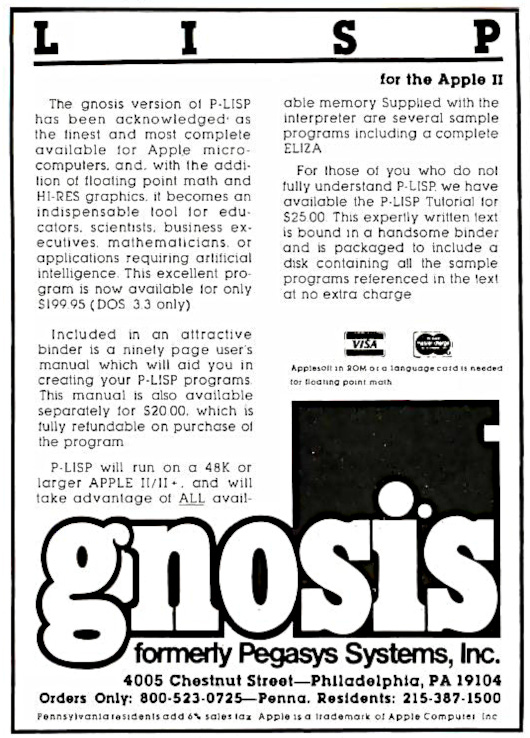
LISP for the Apple ][
The Company
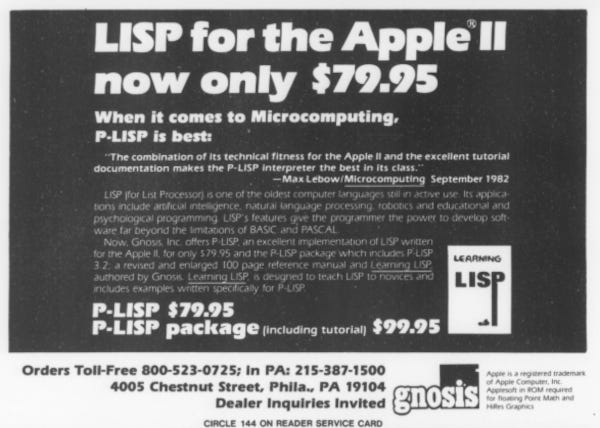
OpenCorporates didn’t have any info on Pegasys Systems or gnosis. I checked out the Pennsylvania Secretary of State site. That states that the company was founded in April of 1981.
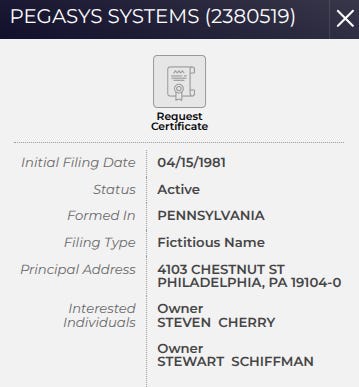
As noted in the ad, the company changed its name in 1981. According to the PA SOS site, the company changed it’s named 3 more time (twice in 1983 and once 1984), but the names are not listed. The site also notes that the business is active, but the annual report is overdue. The last entry for gnosis was in January of 1984.
Softalk noted the first name changed in the December 1981 issue:
“Pegasys Systems (Philadelphia, PA) is changing its name — or at least trying to — after discovering Pegasys Software in Honolulu and Pegasus Data Systems. The first choice, Thesis, was nixed because a small computer retail outlet in Michigan bore the name. According to Stu Shiffman, the second choice, Gnosis (from the Greek word meaning knowledge), will stick and take effect probably in January.”
The gnosis LISP manual says “Published by GNOSIS, a division of Pegasys Systems, Inc.”
The Product
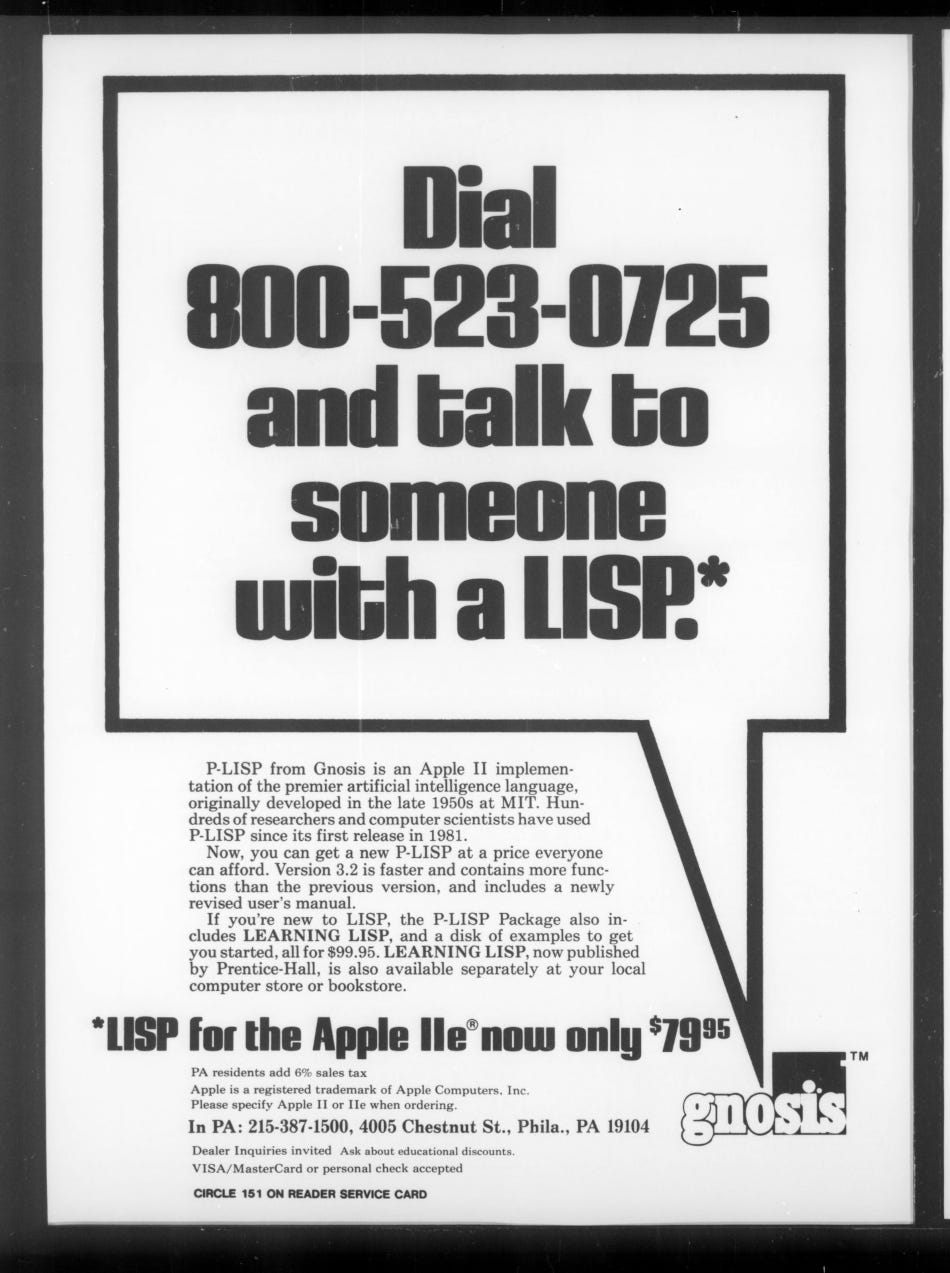
The manual has a short history in the beginning:
LISP was developed in the late 1950’s by John McCarthy at MIT to serve as an algebraic list processing language [LISP=LISt Processor] for work in the then new field of Artifical Intelligence, The first work on implementation began in 1958 and LISP 1 was born. A second version, called LISP 1.5, was completed in the next few years. LISP 1.5 is the precursor of most of the LISP systems in existence tuday. During the 1960’s several other versions were developed across the country for various different machines. MACLISP from MIT, INTERLISP, formerly BBN LISP, and MTSLISP from the University of Michigan are three currently available. The dialect spoken in this book is P-LISP, for various microcomputers, written by Steven Cherry of PEGASYS SYSTEMS INC. Pegasys has now become GNOSIS, Inc.
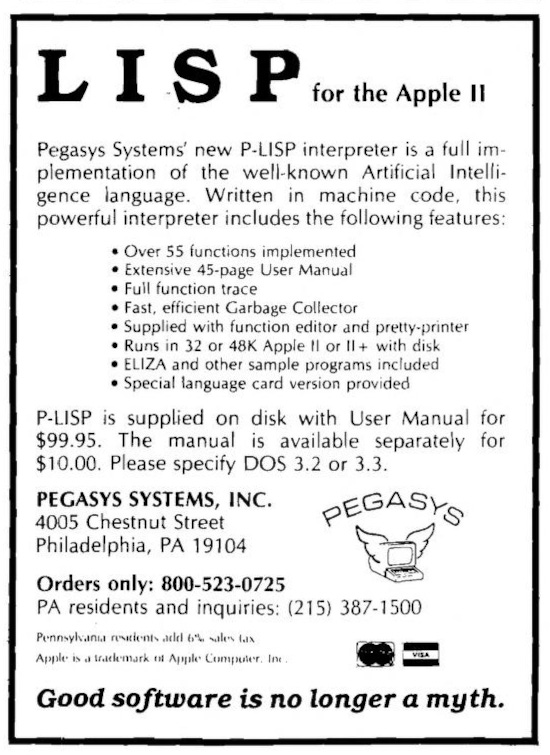
Apple Orchard mentioned it in the Fall 1981 issue:
Pegasys Systems’ new P-LISP Interpreter is a full implementation of the well known Artificial Intelligence language. Written in machine code, this powerful interpreter includes the following features: 55 functions implemented, 45 page user manual, full function trace, fast, efficient garbage collector. Supplied with function editor and pretty printer. Runs in 32 or 48K Apple II or II + with disk. Eliza and other sample programs included — $99.95. Specify DOS 3.2 or 3.3 Pegasys Systems, 4005 Chestnut Street, Philadelphia, PA 19104(215) 387-1500.
inCider Magazine was even briefer in their May 1984 issue:
P-Lisp Now for the Apple
Lisp, a language frequently used in artificial intelligence programs, is now available in a new, faster version for the Apple. P-Lisp version 3.2 features full floating-point mathematics, hi-res graphics and over 70 built-in functions. The P-Lisp package, at $99.95, includes the book Learning Lisp, as well as the interpreter and manual. Contact GNOSIS Inc.
The closest thing I found to a review was a mention in Washington Apple Pi Journal’s February 1984 issue. Frederick E. Naef wrote an article entitled “Implementing an Expert Program”.
WHAT IS P-LISP?
P-LISP Is a LISP Interpreter written for the 6502 microprocessor used In the Apple II. It Is supplied by GNOSIS, a Division of Pegasys Systems, Inc. of Philadelphia. I have been using version 3.0, but later versions are available, and a new release will be available soon for the Apple //e. The program runs well and the documentation, if augmented with additional references. Is sufficient to permit the user to master the language and operation.
The program requires a disk drive and at least 48K of RAM. Since LISP consumes large quantities of memory for internal operations, the program periodically Initiates a garbage collection routine to recover available memory. This routine takes time, and therefore the more memory you have Installed, the faster the program will run, because less garbage collection is required.
The best way to learn is to type in the functions and other lists provided by one of the references, and then debug until It runs. The P-LISP system has excellent trace and debugging facilities, and is very resilient and user tolerant.
Did you ever use gnosis LISP? Do you know anything about its history? Tell us about it in the comments below.

What computer ads would you like to see in the future? Please comment below. If you enjoyed it, please share it with your friends and relatives. Thank you.

Hello'. People greetings from Europe !
Nice Ideal your story on the old i.a. congratulations .... I Remember along that years why in my family a electronics onice family it's that advent a great game or i Remember a game whitout limits in magazine and more !
Gnosis, Inc. was an early microcomputer software company primarily active during the 1980s. It carved out a unique niche in the early days of personal computing by bringing high-level Artificial Intelligence (AI) programming languages to consumer hardware, later pivoting into commercial multi-user business systems.
Comprehensive operational, technical, and historical details regarding the company include:
Corporate Profile & Operations
Leadership: The firm operated under the leadership of company president D. Pickens.
Headquarters: Located in the University City neighborhood of Philadelphia at 4005 Chestnut Street, Philadelphia, PA 19104.Core
Philosophy: During the early 1980s personal computer boom, Gnosis focused on the democratization of complex, mainframe-level programming environments. They engineered tools that allowed students, researchers, and hobbyists to experiment with AI logic on affordable home machines like the Apple II family.
Flagship Product: P-LISP
Gnosis, Inc.’s most prominent historical contribution was P-LISP (specifically popularized around versions 3.1 and 3.2), an interpreter for LISP (List Processing)—the foundational language of early artificial intelligence.
Hardware Support: Engineered strictly for the Apple II, Apple II+, and Apple IIe architectures. It required Applesoft ROM, meaning users with base-model Apple II systems had to load Applesoft via a hardware language card.Memory Management Scheme: The primary bottleneck of 8-bit computers in the 1980s was severe RAM limitation (typically 48K). Gnosis developed a proprietary memory configuration utility within P-LISP. If a user possessed more than 48K of available RAM, the P-LISP software could dynamically reconfigure itself to utilize the extra memory found on an external Apple language card or RAM card, maximizing the execution space for recursive functions.System Delivery: The software was physically distributed on 5.25-inch floppy disks. A copy of the P-LISP interpreter environment is preserved as historical software artifact X3954.2007 in the Computer History Museum Packaged Software Collection.
Memory Management Scheme: The primary bottleneck of 8-bit computers in the 1980s was severe RAM limitation (typically 48K). Gnosis developed a proprietary memory configuration utility within P-LISP. If a user possessed more than 48K of available RAM, the P-LISP software could dynamically reconfigure itself to utilize the extra memory found on an external Apple language card or RAM card, maximizing the execution space for recursive functions.
ystem Delivery: The software was physically distributed on 5.25-inch floppy disks. A copy of the P-LISP interpreter environment is preserved as historical software artifact X3954.2007 in the Computer History Museum Packaged Software Collection.
Educational Literature
Recognizing that LISP was notoriously difficult for beginners, Gnosis operated as a technical publisher to support its software ecosystems
"Learning LISP": In 1984, the company authorized and published a comprehensive educational textbook titled Learning LISP.
Distribution: The book was picked up and mass-distributed nationally by major educational publisher Prentice-Hall (Upper Saddle River, NJ).
Impact: Spanning roughly 200 pages (Library of Congress Control Number QA76.73.L23 L43 1984), it served as a practical, step-by-step workbook that guided users through functional programming, evaluation loops, and data structures using the exact syntax of Gnosis’s software interpreter.
Enterprise Pivot: Manufacturing Systems
By the mid-to-late 1980s, as the consumer market shifted heavily toward MS-DOS, Gnosis leveraged its engineering expertise to transition into corporate business software.
The Product: They developed and marketed a microcomputer-based, multi-user manufacturing controls system.
Target Audience: The system was specifically built for "custom-order manufacturers"—businesses that required highly dynamic tracking of raw materials, job costing, and scheduling rather than predictable, assembly-line mass production.
Technical Shift: This marked the company's evolution from a specialized 8-bit AI software house into a multi-user corporate solutions provider, optimizing local terminal networks to process real-time factory floor logistics.
Public trade directories, such as the Computers and People Computer Directory, list Gnosis, Inc. as fully operational with President D. Pickens at the helm as late as 1985–1987. Following the late-80s market shifts, the company quietly wound down operations, ceased product updates, and dissolved.