
MacWorld Interviewed Paul Brainerd, president of Aldus Corporation (1988)
They talk about Aldus' desktop publishing products.
Note: I was trying to get this done last night for June, but fell asleep. So pretend it’s June as you read this. JPW

From the October 1988 issue of MacWorld magazine
An interview with Paul Brainerd, president of Aldus Corporation
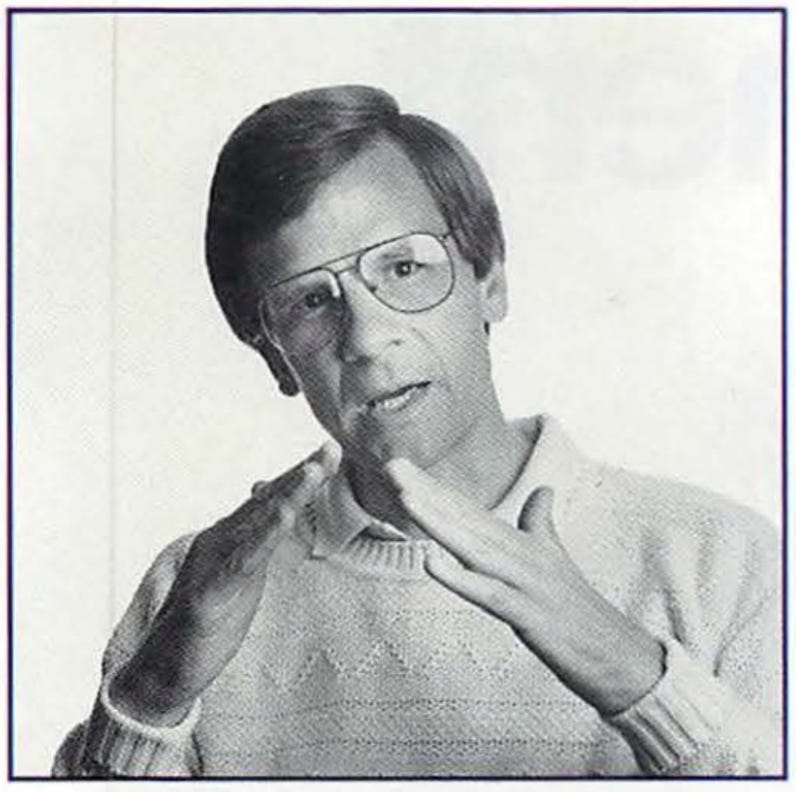
Paul Brainerd sees himself as a bridge between technology in the lab and in our working lives. He filled that role at the Minneapolis Star and Tribune, where he led the transition from hot type to computer-based photocomposition. He went to the other side of the fence after that, working for Atex, a maker of electronic publishing systems for newspapers. When Kodak bought Atex and closed its office in the Northwest, Brainerd and four others from his group formed Aldus, the Seattle company that originated desktop publishing with the introduction of PageMaker, first on the Mac and later on the IBM PC. This year Aldus has introduced FreeHand, a PostScript illustration program, and Aldus Persuasion, a business presentation package. Snapshot, a program that works with a still video camera to digitize images, was introduced on the PC this year and is on its way to the Mac.
Why did you name your company after a Renaissance printer from Venice?
We wanted a name that emphasized human values, rather than technology. During a road trip we took very soon after we formed the company, we stopped at libraries along the way to research publishing history. I came across a passage on Aldus Manutius that impressed me. He was very important in publishing — inventing italic type and standardizing punctuation. More important, he was really an entrepreneur for his day; he brought the academic pursuit of publishing to a much broader audience. That was an example of what we were going to try to accomplish by using the microcomputer. And his name was pronounceable.
Jonathan Seybold has said that proprietary publishing systems have essentially become dinosaurs, giving way to programs for the Mac and other personal computers. Do you agree?
Five years ago innovative newspapers and magazines were already beginning to need standard hardware platforms for their publishing systems. Their publishers saw no reason for the financial reporter to have both an Atex computer terminal for doing the text entry and an IBM PC for doing Lotus 1-2-3 financial analysis of the corporations in the news. The only application area today that still justifies buying a dedicated system is four-color prepress.
What’s the holdup with color?
The high-end color systems made by companies such as Scitex and Crossfield deal with large images of up to 60 or 100 megabytes, and transformations on that much data still require special-purpose hardware, though that’s beginning to change. Photographs get into areas of color correction— matching skin tones, for example — that are more difficult to do on microcomputers. The computer display uses an RGB (red-green-blue) model, and those colors don’t accurately match what we get with the CWYB (cyan-magenta-yellow-black) output of the printing process.
Are the tools for handling process-color available on the Mac yet?
Yes, I think they are, but you have to understand the tradeoffs — the Mac allows artists who could never have afforded a color production system to have one for $10,000. We have to be realistic about the limitations, some of which will be eliminated in another 6 to 18 months. We couldn’t have done an application like FreeHand two years ago; we couldn’t have done PageMaker four years ago because the laser printing technology didn’t exist. We’re always pushing the boundaries of the technology with our products.
What are the limitations of Macintosh technology right now? Desktop publishing with newspaper-quality color? Magazine-quality color?
That depends on the publication, and the environment in which it’s being produced. We can indeed produce magazine-quality results with particular image types, but I cannot recommend PageMaker for the Boston Globe yet.
What improvements does the Mac still need to make it viable as a publishing workstation?
First, the difference between screen display and the printed result, the difference between QuickDraw and PostScript imaging models must be addressed. What you see on the screen closely approximates what you get on paper, but the difference may force you to print several times to correct mismatches in cases where there are very tight fits.
Second, network support and throughput have become more important, and .so has access to larger file service systems. Apple is addressing these changes through its strategic alliance with Digital Equipment Corporation. Publishing people are very concerned with system reliability, particularly people working on newspapers who cannot afford to lose hours to equipment failure.
Will you make a version of PageMaker that would work with PostScript as a display language?
Display PostScript is very important because it eliminates the difference between the screen and the printed result. In fact I think all of our customers would want Display PostScript if it were free. But, of course it’s not free. If it were to cost $300 there would be wide acceptance of it as a display model; at S1500, it would probably interest only 15 percent of the people who use our products.
If a third party were to implement a PostScript display controller board, we could quickly revise our software to take advantage of that.
Do you expect to see PostScript emulators?
We do expect to see PostScript-compatible interpreters, and we will cooperate in testing them because the last thing the customer needs is to start getting products that are supposedly compatible with PostScript but end up not being compatible in some way. The trade press concentration on this development has probably been premature, but I do think we will be seeing PostScript-compatible devices coming to market this year.
Color thermal printers seem very limited in their ability to create dithered patterns that convincingly reproduce colors from the screen. Is ink-jet printing technology likely to do any better?
There are three technologies, each with a different price. Ink-jet has come a long way in the last ten years. Today, some very reasonable devices are being produced. And Hewlett-Packard (among others, including some Japanese companies) is conducting research projects aimed at producing high-quality, color ink-jet printers at a low cost. Typically, to get the low cost (under $2000) the ink-jet printer manufacturers have resorted to moving the printing head across the page, which means it takes about a minute to produce each page. There’s also a finite resolution problem.
The thermal transfer technologies can handle much higher resolutions, but they’re much more costly because they’re almost miniature four-color printing presses on the desk. The most expensive technology today is the color laser printer, starting at $60,000.
Producers of all three technologies are trying to reduce their costs by half in the next 12 to 18 months to achieve broad acceptance in the office. The whole acceptance of color in the office may be dictated more by the ability to copy color, and we’re seeing some pretty exciting products in that area from Canon, Xerox, and Kodak that will make color copies in the office much more widely available.
How does the entry of QuickDraw laser printers affect your users?
The issue of QuickDraw versus PostScript printers has largely been one of cost. We’ve worked with both Apple and General Computer to support their QuickDraw printers. We’ve tried to eliminate as many differences as possible, for example we put the halftone imaging model inside PageMaker to allow photographs to be printed on either the LaserWriter SC or the GCC Personal Laser Printer. That process involved a lot of work for us.
About 80 percent of our customers use the LaserWriter for output; 15 percent use the ImageWriter and then take their files to a local printing service for final output if they need higher quality. As a result, supporting QuickDraw is very important for us, and for our customers.
Do you see fonts to be an issue with the QuickDraw printers?
The fonts used in the Apple SC QuickDraw printer are bitmaps that take up a lot of space on the disk, and you have to have a bitmap for each type size. By the time you add it up, the people who couldn’t pay for a PostScript printer end up having to spend that money anyway for a hard disk with enough space for the number of fonts they need in the System. There are several tradeoffs, and Apple, the press, and the dealers need to make the users aware of what those tradeoffs are.
You’ve introduced a new presentation package that looks very flexible and powerful. When do you think we’ll start seeing presentations that are more than an outline of bullet items?
We’re not going to change the way people communicate overnight. There are educational things, cultural things, that we have to change. When I was a graduate student, I taught the introductory course in visual communication, required for all journalism students. It was appalling to see college students who entered this course, who had gone through grade school and junior high school and high school without learning even the basics of visual communication — things like line, form, color, texture. Without that basic foundation we re not going to make much progress. As a result, we’ve done a lot of work to create materials that allow people to learn these skills.
Aldus has made a big investment in the international market recently. Why?
The international market is not only a key business opportunity, but it s absolutely critical to me personally: I’m interested in taking a message to the whole world, not just the United States. That means designing products to meet different language needs — we currently have PageMaker in 10 languages and plan to have it in 13 languages by the end of 1988 — from French to Japan’s Kanji. The product design issues are very challenging, but even more challenging are the cultural differences from country to country that influence how we present the products, how we provide support and service to our customers and to the local manufacturers of the devices and screens.
Many high-technology companies, and many Americans in general, don’t have an appreciation for the rest of the world. There are 350 million people in Western Europe and their need for our products is as great as the need in the United States.
What are some specific needs of the international markets?
There are some very simple things that we Americans tend not to be very sensitive to. The most common paper size in the world is A4. If you’re in the United Kingdom or France or Germany; would you feel very good about a piece of software that forced you to change the default setting for the page size every time you went to print?
It’s no longer acceptable to sell a software product unless it’s in the local language. That means the manual, the box, all the instructions inside, the help flies, everything is translated into Swedish, into French, into German. You can’t expect international customers to call the United States for support; they need local support. The time and date formats differ. The financial programs must represent numbers and currency and accounting principles according to the national customs.
Is desktop publishing a different animal abroad?
In many places, PageMaker is used just as it is here. But there are some parts of the world where all kinds of publishing are much more limited. In Latin America, you’ll see many small newspapers produced on electric typewriters. The publishers can’t afford silver-based materials for photocomposition, so photocomposition has never been used; it’s been strikeon typewriters or hot-metal line casting. With desktop publishing, we can help the society communicate and get a lot more information out in a very socially advantageous way, information about better health care methods, how to grow crops, and other things we don’t necessarily think of when we consider desktop publishing here.
It’s been said many times that freedom of the press belongs to the person who owns it. Unfortunately, in an industrialized context it costs a lot to own the press; now we’ve reversed that process. Practically anyone with reasonable means can now afford to publish their ideas at a low cost, which is a very positive thing for society.
PageMaker seems to have been designed for people who are familiar with pasting up pages with traditional tools. What about people who’ve never done layout?
Clearly the early adopters of PageMaker were professionals in the field who understood the benefits for them and who immediately went out and bought it. They in turn have exposed PageMaker to a much larger audience of business professionals who would like to use these tools in the office but may be intimidated because they sense that these products are very complex.
We’re trying to deal with these things by evolving the product, and by surrounding the product with training and templates that let people with little design experience create professional-looking publications quickly. We’re working to integrate the templates more with the program so that using them is more automatic. Most business users want to transform their content automatically into finished product.
We haven’t produced the ability to just snap our fingers and it’s there, but our new presentation program goes further in that direction than anything else we’ve done.
Of course, our present customers want more and more features — we compiled a list of over 350 enhancements our customers wanted when we were planning PageMaker version 3.0. At the same time our new customers say, “I want less complexity” We’re trying to add layers to the user interface so that users can have as much complexity as they want, but at some point we may have to divide the product for the graphic arts professional and the office user.
Aldus has also actively promoted training and customer support.
It’s an attitude I formed while growing up. My family had a small business, and I learned that the success of a business like that depends upon repeat business. I’ve tried to take a leadership position in the Mac market, and at Aldus, to advocate that our job isn’t finished when we sell a product. We really have to have a satisfied customer.
Do you think customers choose a program based on a company’s reputation for customer support?
Yes, over 50 percent of our customers tell us they bought our products as a result of recommendations from current users, and I know that when I buy a product, I consider not only the quality of the product, but also the company behind the product. □
Interviewed by Nancy E. Dunn

What computer ads would you like to see in the future? Please comment below. If you enjoyed it, please share it with your friends and relatives. Thank you.