
MicroTimes Interviews Borland's Philippe Kahn (1985)
They discuss a couple Borland products, his thoughts on the future of computers, and more.
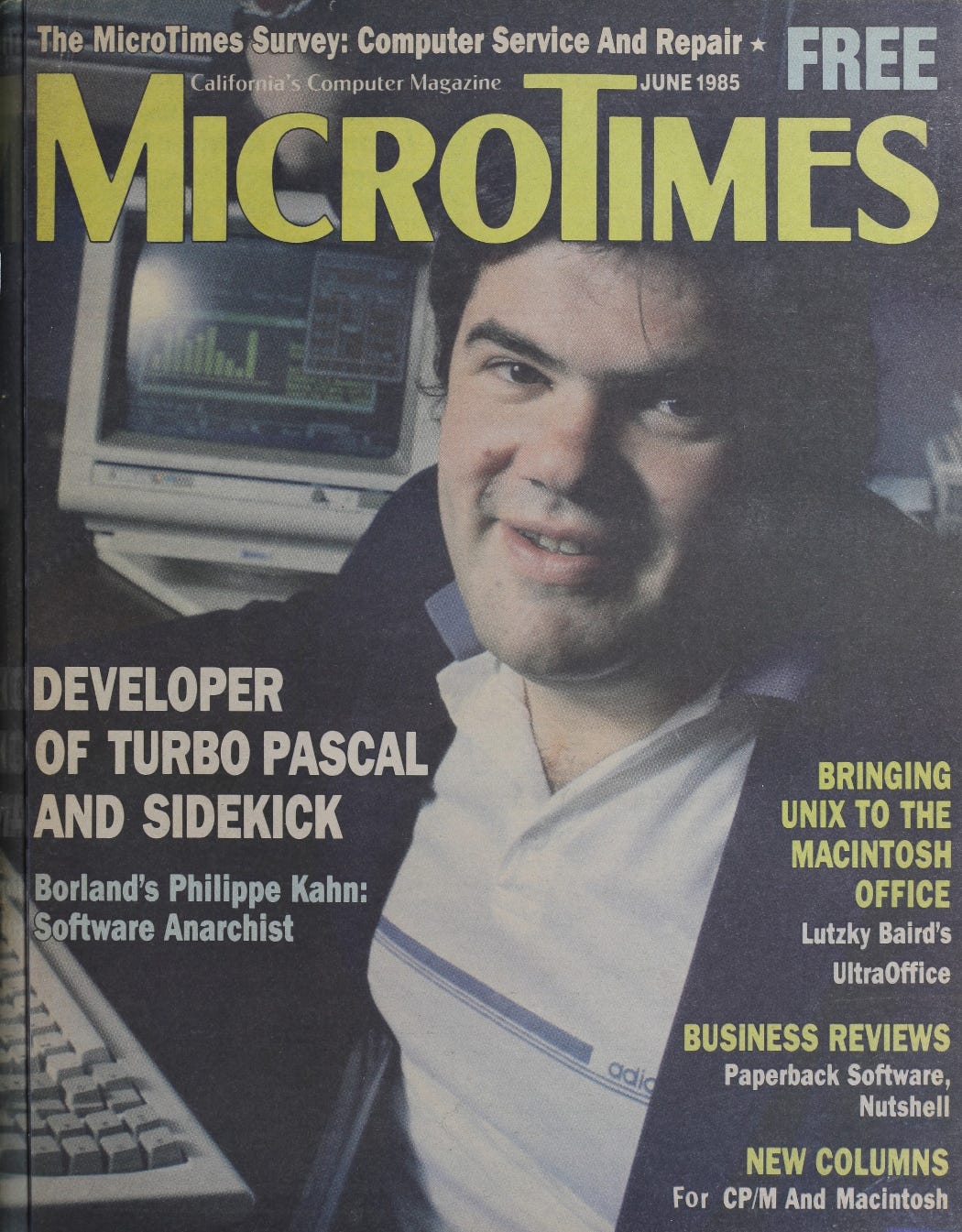
from the June 1985 issue of MicroTimes magazine
Borland’s Software Anarchist, Philippe Kahn
Surprising People And Disturbing The Establishment
By Jeff Spurrier
They said it couldn’t be done, of course: selling top-quality innovative software for extremely low prices. Philippe Kahn, newly arrived from France and unable to find work in the industry since he didn’t have a green card, didn’t believe them. In 1983, he founded Borland International, which, with products like Turbo Pascal and Sidekick, has been turning the software world upside down ever since.
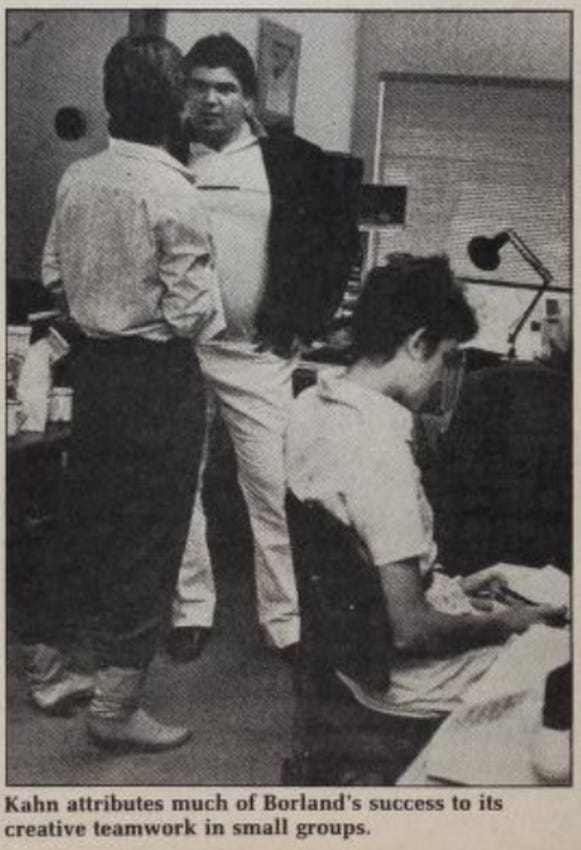
The interview with Philippe Kahn, President of Borland International, took place at the company’s crowded offices in Scotts Valley, near Santa Cruz. In keeping with the Borland image, most of the staffers appeared to be young, friendly, and easy-going. When Philippe Kahn arrived just before noon, he spent a half hour touring the various departments, checking up on what was going on. Most of his own programming work he does late at night at home, he later explained, since when he’s at Borland the daily demands of the company require his attention. Besides having an office at home, he also has a cellar full of electronic keyboards and computers.
Sidekick is one of your biggest successes; in one interview you made its development sound like almost an accident...
Any new idea is almost an accident. If it’s not, it’s probably not that new. If it was possible to arrive at new ideas by logical patterns, then you’d have machines and people trying to do that all the time. It’s like you’re in your jacuzzi and you look at the bubbles and boom! You have an idea. Is that an accident? Of course if you sit at a conference table with ten people and say ‘We’re going to come up with a new product!’ and six hours later you have it knocked out, I don’t believe it’s going to be great.
Is that what’s wrong with a lot of software today?
No, I think what’s wrong with software is the positions (of companies). We have something which I call the Basic Laws of Turbo Dynamics. First: high quality software; second: not copy-protected software; third: reasonable licensing agreements. All this makes what I call good software. What’s wrong with most software today is they fail in terms of copy-protection. That is going to be a major issue in the next year. No matter how you look at it, copy-protection is a hassle to the user. It’s a tax on honesty. It’s like going to the grocery store and every time you leave the store you’re searched. When you go in there they assume you’re guilty. I think it’s a fundamentally wrong idea. It’s a wrong way to start doing business with people. So I think there’s going to be a reaction in the marketplace to it.
Now as for licensing agreements, if you look at the licensing agreement on any product, you’ll need three lawyers to understand what it’s about. Our licensing agreement is called “Borland’s No Nonsense License Statement.” [He then reads verbatim the Borland licensing statement, a brief paragraph which simply states that the software is protected by U.S. copyright law and is to be treated much the same way as a copyrighted book would be. Backup copies are permitted but duplication for use by more than one user at a time is forbidden.]
That’s it. Now compare it with any piece of software. [Kahn then reads a non-Borland licensing agreement.] They don’t guarantee anything. It’s called the “No performance warranty.” Isn’t this amazing? “[Manufacturer] cannot and does not warrant the performance or results that may be obtained from using the program . . . The entire risk as to the results or performance of the program is assumed by you. Should the program prove defective, you and not [manufacturer] shall assume the entire costs of all necessary services and corrections.” [Laughs] Do you know any industry where anyone would dare sell something like that? And the Lotus one is worse. Can you imagine an industry where it’s written on the product that it’s useless, it doesn’t work, and you can’t copy it, and by just opening the package you accept all those terms? Isn’t this crazy? This is what the software industry is about these days.
“No matter how you look at it, copy-protection is a hassle to the user. It’s a tax on honesty. It’s like going to the grocery store and every time you leave the store you’re searched. When you go in there they assume you’re guilty. It’s a fundamentally wrong idea.”
How do your lawyers feel about your “No Nonsense Statement?”
We don’t ask the lawyers. If you ask them then you end up with what everyone else has. That’s what’s crazy. We believe what protects software is copyrights, so we rely on them. Period. Just like books or music. And we contend that our software does what we say it does. The
Turbo Pascal is a Pascal programming language and Sidekick is a resident index software organizer. We don’t say it’s nothing! You just bought nothing! Like with Lotus you just paid $495 for nothing!
At one time Sidekick was copy-protected. I thought...
Yes. That was because this advertising guy that worked here convinced me to copy-protect the product. And when I saw the reaction from end users I immediately released a non-copy-protected version of Sidekick. I also released the advertising guy. That was the first and last time Borland will copy-protect a product. That was June last year.
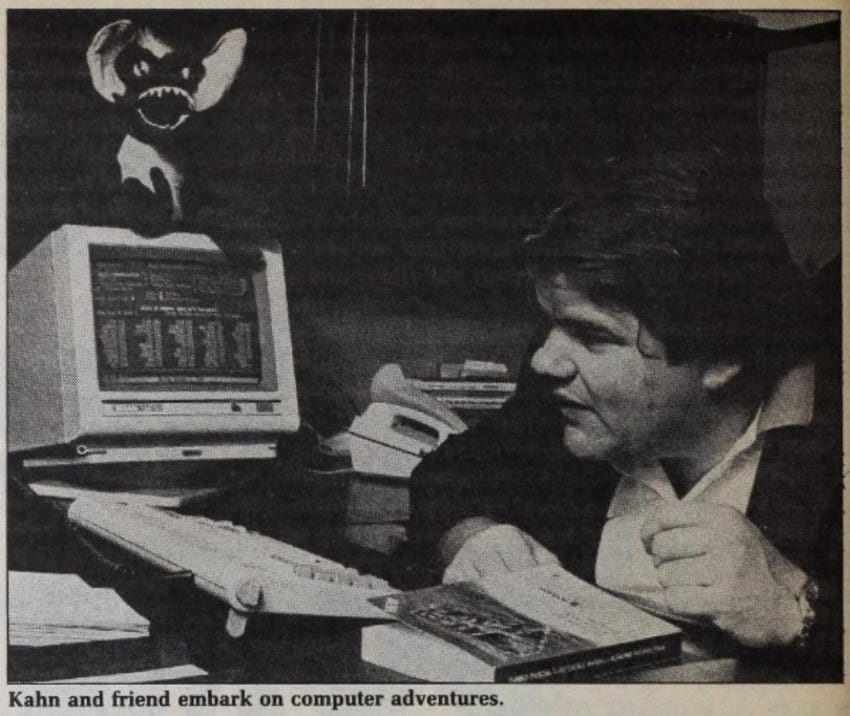
If you are a software publisher, and you don’t use your software yourself, that means you’re in trouble. It’s not useful. And I would never use a copy-protected version of Sidekick. It’s like if you’re in the music business and you never listen to the songs you publish. You’re in trouble. Or if you’re a book publisher and you hate the books you publish. We’re users. We have some 80 PCs in here and everyone uses our software.
Besides copy-protection, what do you think is wrong with most software?
Fundamentally that it doesn’t work. A lot of the people who write software probably never get to use it. A group of programmers are commissioned to write something, and after they finish it they move on to the next task. If they did use it they’d find it’s hard to use, not fast, took up too much memory space. People talk about user-friendly software, but the first element of user-friendly is speed.
And you think that’s the primary cause of bad software — program designers who don’t use their own product?
That’s one reason. A lot of times the motivation for people to make software is to make money, and that doesn’t make good products. It’s the same with music. If you’re making music just to make money, I don’t think it’ll be good music. It’ll probably be okay, if you have talent, but it won’t be good. It’s the same with software. You have to like what you do, have fun at it. It has to be a creative environment in the company — which is often not the case. I don’t believe having more than 10 or 15 people doing programming in one location is productive. Lotus has a hundred people in a building doing development. That kills creativity.
Why?
Too many people and too much oranization. Nobody knows anybody. No one can manage that. I believe in teams of ten or fifteen who know very well what the other guys are doing and act as sounding boards and are isolated and get excited about small projects.
“A lot of times the motivation for people to make software is to make money. And that doesn’t make good products. It’s the same with music. If you’re making music just to make money, I don’t think it’ll be good music.”
A lot of your catalogue is language-related programs. Why?
Communications. That’s how you talk to computers. We believe that’s serious business. If you want to build a company that’s here in the long run you don’t want to be in the hits business. Lotus is in the hits business. They’ve got 1-2-3, and they need another one. And because they can’t find another one they have to become an obnoxious sue-people copy-protect software company to protect their revenue.
We believe the backbone of our business is programming languages because they’ll always be around. It’s not a hits thing, it’s a necessity. For education, for business, for hobbyists. That’s our main strategy now. We will have the Basic language, C, Modular 2, assembler, with the same strategy — a whole group of products [like the Pascal series]. Look at MicroSoft, that’s a solid company. They built the company around languages. The hits business is fun and we’ve got two hits now, Sidekick and Super Key. But one day we’ll miss, and if you base your whole strategy upon hits you’ll be in trouble.
You’ve made a point of avoiding borrowing money to build Borland through venture capital, yet everyone else in the industry does this. Why are you so adverse to venture capital?
Because we want to be independent. As soon as you have outside investors then you have to abide by their rules — copy-protect software, protect the company with stupid licensing agreements. We want to do business our way and I think our end users respect us. By protecting our customers we do protect our shareholders. Most companies don’t believe that. It’s a different philosophy [from most software businessmen]. People in this business are too greedy to get rich. We never started this company hoping to become millionaires, just to make a decent living. I didn’t have a choice. I was broke and no one wanted to hire me in those high tech jobs because I didn’t have a green card. The idea was to survive. We probably have become “millionaires” although I haven’t ever checked. That was never the goal and that’s probably why it worked — because it wasn’t important for us. What was important was to have fun and make great products and make our customers happy.
“A lot of software companies are saying, ‘Borland’s not viable. You can’t make a business by selling software at this price.’ So why do they worry? Why do they scream? Well go out of business. I think by now they know we won’t.”
Is there any plan to bundle your software with hardware or software manufacturers? Recently you signed a deal with AST to include Sidekick with every board they ship...
We don’t bundle. I hate that word, I hate the words “free software.” Those terms were invented by Adam Osborne and now that he’s in the software business he feels bad about it. Software is not free and if you give the people the idea that it is, then, sure, they’ll copy it and rip you off. The AST deal is a distribution agreement — a fantastic distribution deal for us. They ship over 40,000 boards a month and in addition to what we sell, more than 40,000 other people are going to get an edition of Sidekick and a catalogue of Borland products. It’s a distribution deal, not a bundling.
Usually when they have bundled or free software it’s second-rate software that’s not selling anymore and they put it with hardware to generate revenue. Sidekick is a best-seller now. What we did was take the best-selling add-on piece of hardware for the PC, which is the AST SixPak Plus, and the best-selling product for the PC besides 1-2-3, which is Sidekick.
It’s a joint venture, an alliance. We believe in putting our products in as many hands as possible. There might have been some resistance because of how low we price our products. People say, “I didn’t buy Sidekick because it was too cheap. I bought the expensive one.”
Do you think that people think that Sidekick is a game because it’s priced so low?
I hope people do think it’s a game.
Really?
Sure. If it can make your daily work like a game instead of work, it’s wonderful. If using business software can feel like playing a game that’s great. That’s one of the taboos. A computer should be fun to use.
Do you think your low prices upset other software manufacturers?
I don’t care if it upsets them or not. I think it pleases our customers. If they’re upset then there’s a problem.
A lot of software companies are saying “Borland’s not viable. You can’t make a business by selling software at this price.” So why do they worry? Why do they scream? We’ll go out of business. They shouldn’t worry about it.
I think by now they know we won’t. I think it’s a general trend. Software prices will go down, and we’ve been the ones that have done it first, and we’ll continue to push them down to reasonable levels. It’s true in any industry, it always happens. Software was a new industry. Now you have 8 million PCs so you don’t need to sell a piece of software for $600 to make a good living if it’s a pretty horizontal product.
I’ve heard that sometimes you log on to the Go Bor board on CompuServe to chat with users. Why? How do people react when they realize they’re talking to the head of Borland?
With amusement. I do it because we want to be end user oriented, so we want to hear what they have to say.
And what do they say?
Suggestions. It’s amazing how by listening to them you can have great ideas for products. Instead of having three or four guys here trying to think of new products you suddenly have 25,000 people giving you great ideas. For free — if you’re willing to listen. I always want to see the complaint letters as well as the compliment letters. We don’t get too many complaints but sometimes we do. You get a lot of suggestions by users, because they do different things with the product and might have ideas you didn’t have, because you didn’t use the product with some other software or some specific condition.
Are you open to outside developers submitting to you?
We are, but we haven’t seen anything we want yet that will meet our criteria. So far we develop everything ourselves. I’m very scared of the VisiCorp/Software Arts syndrome. Software Arts developed VisiCalc for VisiCorp and then they started fighting about it. Software Arts wanted the glory and more money. They were getting $14 million a year just to sit there. Two guys. They didn’t upgrade the product for VisiCorp, so they lost the market and Lotus came in and bought them out. So we’re very scared of that kind of relationship. I believe in controlling your technology. As long as you control your technology, you have the ability to create new versions, upgrade your software.
Do you worry about industrial espionage?
Within the company? Yeah, we’re becoming more cautious. We’ve been had a few times. One guy left with a few ideas we’d had and tried to start his own company, but he failed because he didn’t have the ability to make software. Thinking of ideas is one thing but making it work is another. He even raised capital and persuaded investors that he had good ideas. So now we’re very careful about new ideas.
What do you see in the future for software design?
I don’t think anybody sees the future. If people tell you they see the future, don’t believe them. When a company becomes established — as we’re starting to do — they like to say they can see the future. But no matter how you look at it, a couple of guys in a garage somewhere — like we did — will come and show everybody. That’s the beauty of the software industry. You don’t need big capital investment to make a great piece of software. People say it’s a marketing game, but that’s not true. It’s a technology driven game. If you don’t have the marketing you might fail. But if you just have the marketing and no product you’re sure to fail in the long run. You must have good products. That’s cast in iron. You can’t create something out of nothing.
You have children. What do you think kids will be doing in 20 years on computers?
Kids are amazing because they’re not afraid of programming like adults. Twelve-year-olds will start writing Pascal programs right away. My impression is that [future kids] will blow us out, make us look real bad. They’re so natural and in tune with the object. It’s going to be tough coping with them. It’s like someone who touches his first piano at 20 compared to a kid who starts when he’s four and he’s a natural. Like young Mozart and Salieri in Amadeus. It’s amazing. I see my kids and they understand things so easily. We’ll see lots of new directions in software coming from kids because it’s the first generation that has had real tools, real computers at the age of five or six. What kind of musicians would we have if nobody could touch a piano until he was in college? Suddenly you’ve got a whole generation who has gotten computers when they’re five or six and they have lessons and and they have them at home. It’s a big difference.
How old were you when you saw your first PC?
Probably 15 or 16.
Do you remember what you did with it?
Sure. I had a summer job programming geometrical shapes for numerical control machines. You had a machine that would make metal parts, and it was driven by a computer. You needed someone who would translate a drawing of a shape, like a bolt, into mathematical equations and then into the language which the computer would understand. It was a very non-creative job. And then later at university we had mainframes. My first PC was an Apple II, in France. That was the first I had at home that I could play with, with an assembler and all. It was a good machine. It was a great toy.
“Apple had this wonderful $2 billion company and they thought, ‘We’re going to take on IBM/ That’s arrogant You can’t be arrogant with IBM. IBM is like a machine.”
What do you think Apple is doing these days?
I don’t know if they know what they’re doing. It’s really sad. Like a lot of people I think Apple made the industry. I would hate to see them disappear, because it’s healthy to have competition. An IBM-owned world isn’t a good world. IBM needs competition and Apple had the glow and the aura to compete. But they made a fundamental error with the Macintosh by closing the architecture of the machine. They’ll probably survive — I hope so — they’re rumored to have other machines. But what’s still making Apple is the II and the lie. It’s not the Mac. It’s amazing. The II is a dinosaur if you think about it. People say the PC is a dinosaur also, but the II is really a dinosaur. The II has been there for years. Everybody’s hat should be off to Steve Wozniak. Everybody talks about Steve Jobs, but the reason Apple’s here today is because of Wozniak’s Apple II motherboard. I think the problems Apple has now is because the II people and the Mac people are fighting for recognition and it’s obvious the II people should have it. They made the company.
Would you like to design hardware? What’s the ideal computer?
Maybe no computer. It should be transparent to the user. You just think about it and it logs on.
The problem with those stupid computers is that they’re very powerful when you have them, but when you’re somewhere without them and that power you’re lost. The hardware business is crazy. I wouldn’t touch that for the world. Making another PC today is crazy. How many IBM compatibles are there — 80, 90? What are they bringing to the table? Nothing.
Essentially there is IBM, Apple, and then Atari and Commodore. Apple’s main error was like what happened with minis and mainframes. There are all these companies like DEC and Data General that never realized that their real [mainframe and mini] market was the non-IBM customer. They all focused on IBM, never realizing their support base was the non-IBM market. Apple until now has not realized that their market is a non-IBM market. They can’t look at IBM’s market share and say “We’ll eat a slice of it.” They won’t. That’s IBM’s. Traditionally. And Apple is going to be in trouble until they realize that, because Atari and Commodore and Wang and all these other companies will eat up the non-IBM market while they’re focusing on IBM. It’s a fundamental strategic error. They had this wonderful $2 billion company and they thought “We’re going to take on IBM.” That’s arrogant. You can’t be arrogant with IBM. IBM is like a machine. And even now they’re still trying to go after IBM and show IBM people as bad guys through those ads — which are very creative, but do they sell PCs? I don’t think they ever sold one more Apple because of those ads. They’re image ads. And every time you waste money by selling image, essentially your customer is paying for it because your costs are going up.
You don’t sell image?
No, we don’t sell image. We sell products. All our ads sell products — not the company. We want people to buy products. Otherwise you end up building a cost structure that’s not manageable at the price levels we’re selling products. And then the consumer ends up paying the bills.
I get involved in the advertising and the R&D. I think advertising should be like news so that people learn something from it. I don’t want people to think we’re selling soap, with wonderful images. We do everything ourselves. We do all our R&D, our advertising, our banking — we don’t have loans. We live in a little closed world here. And it’s kind of fun.
What software do you like (besides your own) that’s out now?
I do like our software. I like Wordstar still.
No Microsoft Word?
I think there are good ideas in it. They did a good job but it’s too buggy yet and too slow for me. Wordstar is much faster and more powerful. I use Wordstar still, even though I have Word. I don’t use database managers because I’d rather write them in Pascal with our toolbox. It’s much easier to do and much faster and more efficient. And I have more control over things. The spreadsheet I like the most is SuperCalc 3. It’s much better than 1-2-3 even though that’s the standard.
You’ve made the comparison between software and book publishing. Do you really see the comparison so strongly?
There is a comparison in the act. We’re selling a book with a diskette that sells for a little more than a hardbound book and we sell in much the same fashion. That’s about where the comparison starts and ends.
When you buy a book you don’t expect the characters in the book to change all the time. Software changes. It bugs, it reacts differently, it moves. You have upgrades. A book might have a new preface in the 2nd edition but that’s all that’s different. And you don’t have technical support for books. And the process of creating also can’t be forecast. It’s a creative process — an accident like I said earlier. From that point on it’s hard work, scientific work, coding, choosing algorithms. Getting things to work. There’s nothing artistic about it. It’s almost like playing a whole tune and then having to write it down in staff notation. There’s not much artistic about all that — just hard work.
Do you see a connection between programming and music?
I don’t know if there’s a connection but I know that most people that are involved with software somehow are also involved with music — either they can play or have played or listen a lot. I carried my way through college playing music as a semi-pro in France. I used to play saxophones.
You don’t play anymore?
Only when a party gets wild enough or I’m drunk enough to pick up a horn. I don’t have time [to play] anymore.
Do you sometimes feel that maybe you got sidetracked from music? Would you rather be playing music?
I wasn’t good enough to make a decent living at it. I like music, but you have to be damn good to make a decent living and be able to play the music you want to play. Most of the people I know who play music professionally don’t play what they want. They do studio sessions, marriages, stupid stuff. They’re making money okay, but I think they’re having less fun than I’m having doing this, doing software. I was into modern jazz and that’s really no way to make a living. Rock maybe but modern jazz . . . who makes a living? Not even the best guys. So, there are no regrets.
Do you foresee increased software competition coming from outside the U.S.?
Sure. If you look at the costs of development in the U.S. and programming here, smart companies will do what hardware makers did with production by setting up production facilities in Hong Kong or Taiwan. Development will happen overseas. There’s no question. You already see it in the game business. A lot of the arcade games are not written in the U.S. anymore — some are written in the Eastern Bloc even.
Really?
Yeah, the Eastern Bloc is going to provide a lot of software development. We ourselves have two development centers overseas (one in London and one in Copenhagen) and we intend to set up a development thing in India also. You get excellent mathematicians and programmers there and the salaries are ridiculous compared to what you get in the U.S. A Ph.D. in India costs you $400 a month — and those people are smart. With hardware you need a lot of equipment. With software you don’t need anything. Just a PC and a plug, and then you need a little brains. Software is freedom. Software is a direct extension of the human mind. It’s just getting the machine to do things. It’s not making dreams come true.
“Software is freedom. Software is a direct extension of the human mind. It’s just getting the machine to do things, it’s not making dreams come true.”
Why don’t you have a development center in France?
We have a saying in French: “No one is a prophet in his own land.”
Do you think it’s still possible for two guys in a garage to build a multi-million dollar software company?
Sure. We did it. If they have a great idea, no problem. People who say it can’t be done just fear that it can’t be done. I say it can be done. It’s tough, but when we started everybody said it couldn’t be done without $10 million in venture capital. But we did it. It’s just people who love it to be impossible who say it can’t be done — large software companies probably.
What kind of image do you think Borland has in the Silicon Valley?
Crazy guys who are trying to turn around the industry. I guess that’s the image — software anarchists who do street marketing. That’s the image I want the company and myself to have, that we’re the wild cards. Whatever happens at Borland will surprise people and disturb the establishment. Maybe [the image is] the punk rockers of the software industry.
BREAKING THE RULES PAYS OFF
Ever since Borland International set up shop in late 1983, the small software house has refused to play by the rules. Besides offering drastically lower prices for top quality software, Borland went against the tide by concentrating on the less glamorous side of software — language programs, specifically Pascal-related programs.
Despite initial skepticism from industry insiders, Borland’s debut offering, Turbo Pascal (released in November 1983) sold over 15,000 copies in four months. Within a year it had sold more than ten times that amount.
That success was far surpassed by Borland’s second product, Sidekick, an “electronic organizer” that features a set of interactive, integrated windows, allowing a user to perform a variety of tasks without leaving a resident program. With Sidekick in operation, one can have 1-2-3 or Wordstar loaded while having the ability to take notes, do calculator computations, dial the phone, jot down appointments on a calendar, or perform ASCII conversions at the same time.
As Borland approaches its second birthday it has a full range of Pascal programs on the market including Turbo Pascal (for Z80 and 8088/86 microcomputers), Turbo Pascal 87 (for 8087 support on 16-bit machines), Turbo Toolbox (a program that works with Turbo Pascal and includes fast file access and sort capabilities), Turbo Graphix Toolbox (which provides a set of graphics to be used with Turbo Pascal) and Turbo Turtle (an introduction to Pascal with guidelines for developing assembly language procedures). Superkey, shipped in February, is a keyboard enhancement program which allows users to design a keyboard for their own personal use, replacing frequently used commands and/or text with a single keystroke.
Despite its small catalogue, Borland is clearly doing something right. The company was named “Company of the Year, 1985” by PC Magazine, and Sidekick was named “Product of the Year, 1985” by Infoworld. In addition, Turbo Pascal was included in the Top Ten Products of 1984 by PC Week and the language has been selected as the official language for a national student programming competition.
And what’s up for the future? Philippe Kahn knows but he’s not talking . . .
“Oh, there are lots of new things but our policy now is that when something new is ready we’ll call a press conference to announce it and the same day we’ll ship it,” he says. “We’re working on six or seven products now but there’s nothing we want to pre-announce.”

What computer ads would you like to see in the future? Please comment below. If you enjoyed it, please share it with your friends and relatives. Thank you.