
MicroTimes Interviews Lord British (1986)
They discuss his background and his games
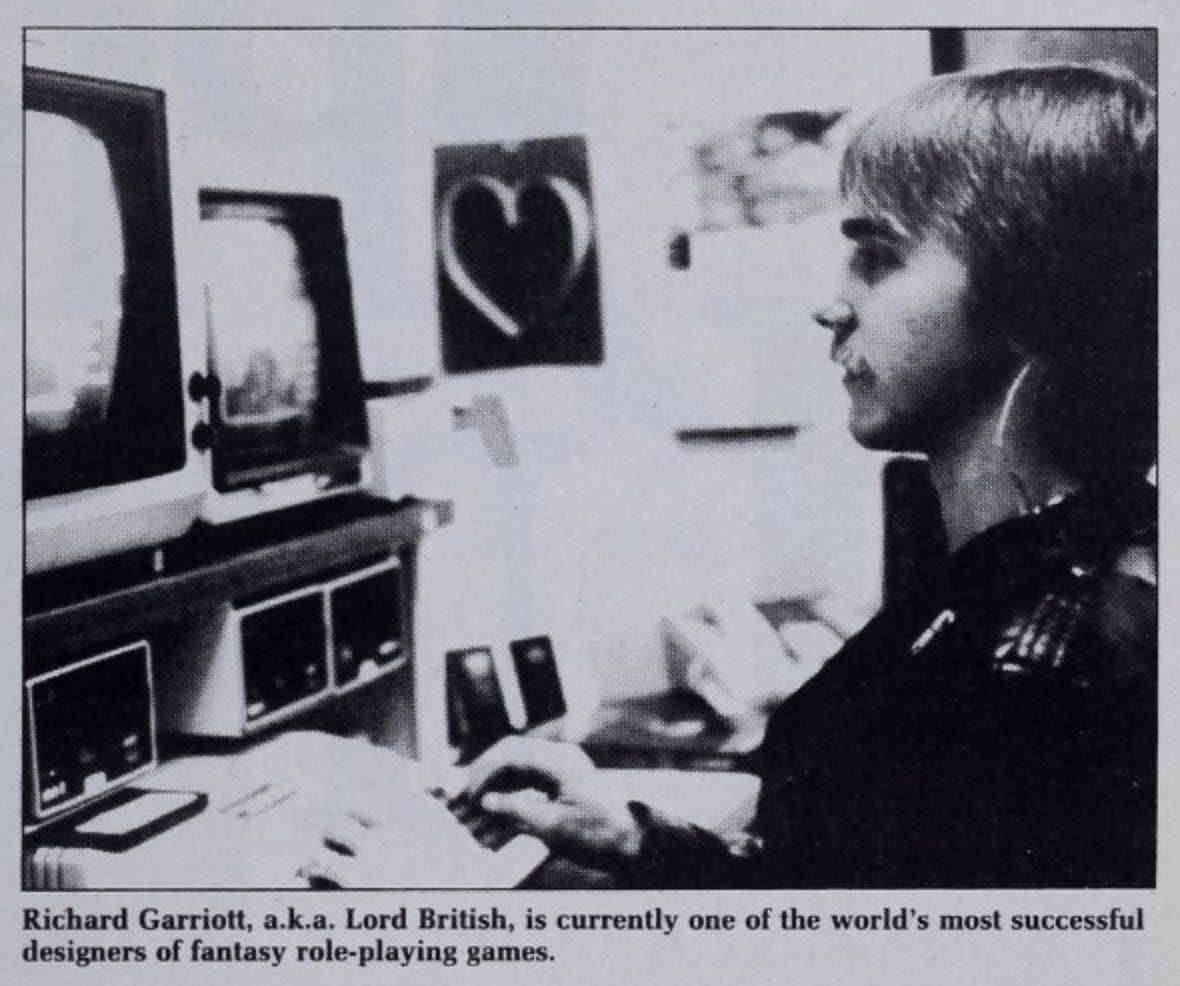
from the May 1985 issue of MicroTimes magazine
Creator Of The Ultima Series: Lord British Speaks
By Mike Markowitz
Born in Cambridge, England, but raised in Houston, Texas, Richard Garriott was nicknamed “Lord British” by his high school classmates (who were amazed by his habit of saying “hello” instead of “hi”). He used the name for his characters when he started playing Dungeons and Dragons, and continued to use it as his nom de computerre as he became one of the most successful designers of fantasy roleplaying games. His accomplishments include designing the popular Ultima series and co-designing the new release Autoduel. We recently had an opportunity to speak with him about his work.
What was your first computer?
An Apple II, before the plus. Until recently I worked on a very souped-up II +. Now I mostly use a He with everything: an accelerator, and the new 3.5” drives, and extra RAM. Recently westandardized on the Merlin assembler running under ProDOS.
Can you talk about any current projects?
Ultima V should be out in a year to 18 months. We’ve been working on it for about a month. It will use bit-mapped graphics, so that, for example, when you fire an arrow, you will see the arrow shape move across the screen, not just a blob of light.
Will it still fit into 64K of memory?
Yes. The main code will be more modularized. It’s entirely in assembly language. The “world” will be twice as big; it’s made up of 512 “tiles” rather than the 256 “tiles” used in Ultima IV, for example.
Will the game be translated for other machines than the Apple II family?
Yes. On the Apple IIe we may have to use the extended memory for the music and sound effects.
How important is sound in a computer game?
You try to envelop as many senses as possible in a game, but you have to make the sound believable. A good example is [Electronic Arts] One On One on the Amiga. They actually went out and recorded the crowd noises at a basketball game. When you sink a good shot, you can hear the crowd go wild.
Do you play other designers’ games?
I used to, but not lately. There’s been a bad void of role-playing software lately. The kind of games I like to play aren’t as involving as something like Ultima — I like short adventure games.
Will the 68000-based computers like Macintosh, Atari ST and Amiga radically change the kinds of games that we’ll be seeing?
Not yet. The problem we have is that a viable, marketable product needs a big audience. The current games push the 8-bit machines to the limit of performance, but if we developed something like Ultima for the Amiga, using all that power, the game couldn’t be converted back for the 8-bit machines — not without completely re-writing it.
“I don’t believe that movies and games have a major adverse effect on anybody’s life. But I think it’s important to write so as to not reinforce negative things. For example, in Ultima IV we played down the stealing, which is a major device in a lot of games.”
When do you think the 8-bit computers will reach a dead end for game design?
Not for two or three years, easily. Look at all the current enhancements for the Apple II, for example. The 6502 microprocessor may only run at 1MHz, but it has a very streamlined instruction set.
What would you like to see in the next generation of machines?
My philosophy on how to design a computer? Well, start with a good fast processor — it doesn’t matter which one. You need a good graphics chip like the Amiga and the ST have. You need a good sound chip that supports realistic stereo sound. And of course, a lot of memory — at least a megabyte. You don’t really need a lot of ROM.
Do you see any potential for games in the laser compact disk (CD-ROM) technology?
Not yet. The realistic video is great for games, but the seek time is still too long. You need a drive with multiple read heads — at least two or three heads. With one head, you have your character come to a fork in your maze, and when you decide to go left or right there’s that noticeable delay while the drive loads the next picture.
What’s your feeling about violence in games?
That’s been a running issue. I don’t believe that movies and games have a major adverse effect on anybody’s life. But I think it’s important to write so as to not reinforce negative things. For example, in Ultima IV we played down the stealing, which is a major device in a lot of games.
What advice would you give a would-be game designer today?
Much different from what I would have given one or two years ago. It’s getting harder, A good idea isn’t enough now — quality and professionalism are much more important. You need the expertise of a publisher to work with you from day one.
If you finish an entire game on your own, the odds are it won’t be marketable. The thing to do is start the game — design the world and get the graphics down. Then send the idea and some brief code around to the publishers.

What computer ads would you like to see in the future? Please comment below. If you enjoyed it, please share it with your friends and relatives. Thank you.
I had to look this guy up. He's about a month older than me, and there's a few Wikipedia pages devoted to him and his creations.
His Father was an astronaut on SkyLab, and Richard himself spent 12 days on the ISS back when you had to hitchhike on a Soyuz rocket to get there and back. His accomplishments and contributions are numerous. I'm surprised I had never heard of him before - perhaps it's because I have absolutely no association with computer gaming of any kind. Still, I think I would have heard of him before.
Great write up. I really enjoy receiving your "Computer Ads from the Past" series in my inbox.
Really interesting how the market viability concern shaped his design choices even back then. That bit about not being able to push the Amiga's full power because it'd lock out 8-bit conversions is basically the exact same tension modern devs face with cross-platform releases today. Had agame project in college where we overbuilt for one platform and learned this lesson the hardway—sometimes 'good enough' for the bigger audience beats 'amazing' for a tiny niche.